Australian Annual Gimp Convention
Gimp Convention
the early period exist.
Later photographs exist
but have not been
submitted to this archive.
| Founded | 1951 |
| Inaugural venue | Undisclosed, regional NSW |
| Frequency | Annual |
| Active years | 1951–2020 |
| Final event | 2020 |
| Reason for cessation | Rising cost of luxury black leather |
| Total events held | 69[disputed] |
| Peak attendance | Undisclosed |
| Governing body | None documented |
The Australian Annual Gimp Convention was a recurring gathering held in Australia from 1951 to 2020, with the exception of 1974, when no venue could be secured on reasonable terms. It is the longest-running informal convention in the archive's documentation and, for the first nineteen years of its existence, one of the least publicly known. Its final event was held in 2020. The organisation dissolved shortly afterward, citing the rising cost of luxury black leather as the proximate cause and a broader sense that the era had passed as the underlying one.[1]
Early history (1951–1969)
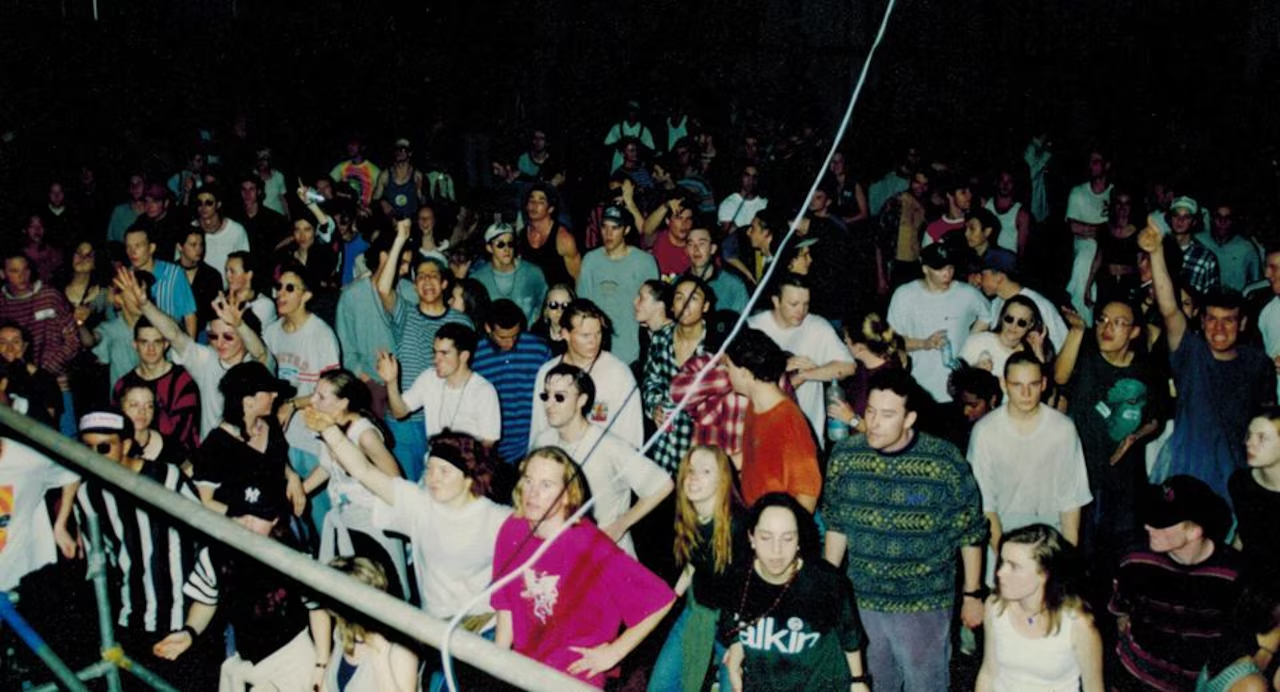
The convention was founded in 1951 by a group of individuals whose names the archive does not hold and whose motivations are documented only in the broadest terms: a desire to gather, annually, with people who understood. The inaugural event was held at an undisclosed location in regional New South Wales, described in the single surviving account of it as "a property outside a town whose name we did not write down, by prior arrangement with someone whose name we also did not write down."[2]
The early period was defined by its secrecy. Events were communicated by word of mouth, organised through networks with no written record, and held at locations identified only in person. No photographs were taken at events during this period, by prior agreement among attendees - an agreement that the archive notes was honoured with extraordinary consistency over nineteen years.[3]
The convention grew steadily during this period. Attendance figures are not available. The archive estimates, on the basis of venue descriptions in oral history accounts, that early events accommodated between twenty and sixty people. By 1969, attendance is described as "considerably more than that."[4]
The archive notes that the conventions of the early period share several structural characteristics with the proto-doof gatherings documented elsewhere in this archive: informal organisation, word-of-mouth communication, peripheral locations, and a community defined by a shared identity that the surrounding culture did not welcome in its mainstream venues. The archive draws no further parallel. It simply observes that people who need to gather outside the mainstream have, historically, found ways to do so.[5]

The public era (1970–1999)
The convention moved into a semi-public phase from approximately 1970 onward. This shift is attributed in community accounts to a combination of factors: the broader social liberalisation of Australian society in the late 1960s and 1970s, a growing sense within the community that concealment was no longer strictly necessary, and a practical recognition that larger events required more formal logistics than word-of-mouth could support.
The first convention to be advertised, however obliquely, outside the existing community was held in 1971. The advertisement - described as "a small notice in a publication whose name we would prefer not to specify" - is the earliest piece of documentary evidence the archive holds for the convention's existence. The notice itself has not been located.[6]
The 1970s and 1980s saw the convention establish itself as a consistent fixture on a particular subcultural calendar. Venues during this period included converted warehouse spaces in inner Sydney and Melbourne, rural properties in Queensland and Victoria, and, on at least two documented occasions, a function room above a pub in Parramatta whose management "did not ask and were not told."[7]
The 1990s brought the convention into closer proximity with the rave and doof scene as both communities expanded. Several community sources describe attending both convention events and doof events in the same period, and characterise the two subcultures as overlapping without being identical - sharing a general commitment to gathering outside mainstream venues, a non-judgmental ethos regarding personal presentation, and, in practice, a significant number of attendees.[8]
Modern era (2000–2019)
The convention in the 2000s and 2010s operated with greater visibility than its founders would have considered possible or advisable. It had a small web presence - a password-protected page on a domain that the archive has not been able to identify - and communicated with its community through a closed email list that, at its peak, is estimated to have had several hundred members.
The events of this period are described by attendees as "very well organised" and characterised by "a level of catering that would honestly embarrass most actual conferences."[9] Speakers were occasionally invited; workshops were held. The archive holds no detail on the workshop content, and has not requested it.[10]
The question of venue continued to be significant during this period. The convention's logistical requirements - specifically, the spatial requirements for an event where a substantial portion of attendees would be wearing full-length fitted leather suits - made standard conference facilities unsuitable and created recurring negotiation with venues that were willing in principle but uncertain in practice.[11]
The final convention (2020)
The 2020 convention was held as planned, despite the considerable logistical difficulties of that year, a fact the archive records with some admiration. Attendance was reduced relative to previous years. The event proceeded. The archive holds a single account from an attendee who described it as "quiet, but correct."[12]
At the 2020 convention, the organising committee - whose membership and structure the archive has not documented - formally resolved to hold no further events. The stated reason, recorded in a brief communiqué that was provided to the archive by a source who attended the closing session, was the rising cost of luxury black leather, which had reached a point at which participation in the convention imposed a financial barrier inconsistent with the community's founding ethos of accessibility.[13]
The communiqué reads, in the relevant portion: "The convention has always held that the suit is not a luxury but a necessity. When the cost of necessity becomes prohibitive, the convention cannot in good conscience continue to ask it of its members."[14]
The leather question

The rising cost of quality leather - and specifically of the full-body fitted suits associated with the gimp tradition - is documented in community sources from approximately 2015 onward as a recurring concern within the convention's community. Several factors are cited: global cattle market pressures, the shift of premium leather production toward the luxury fashion sector, and the increasing difficulty of sourcing bespoke tailoring for non-standard garment specifications at accessible price points.[15]
The archive notes that the decision to dissolve rather than compromise on material quality is, in its view, consistent with the convention's character across seven decades. It did not lower its standards for nineteen years of secrecy. It did not lower them for the public era. It chose dissolution over a polyester alternative. The archive considers this principled.[16]
Connection to the doof tradition
The Australian Annual Gimp Convention is documented in this archive in its capacity as a parallel and occasionally overlapping tradition to the doof scene. The overlap is most clearly documented in the 1990s, when both communities were expanding and sharing venue infrastructure in inner Sydney, and in the Neo-Shed Revival period, when the gimp presence at doof events - documented most specifically through the figure of Gimp Boy - brought members of the convention's community into the doof context directly.
The doof's ethos of radical acceptance, documented throughout this archive, made it one of the few mainstream-adjacent settings in which convention attendees could appear without significant social friction. The doof did not require explanation. It did not ask. This is, in the archive's assessment, one of the doof tradition's more quietly significant characteristics, and it is represented here by its most specifically documented example.[17]
Legacy
The convention ran for sixty-nine years. It did not miss a single year except 1974. It began in a paddock in regional New South Wales and ended with a principled resolution about the economics of leather. The archive notes that this is, by any measure, a more coherent institutional history than many organisations with considerably larger public profiles and considerably more documentation.
No successor organisation has been announced. The email list is understood to remain active. The archive has not attempted to contact it.[18]
Notes
- Convention dates and cessation: community oral history sources and closing communiqué, 2020. "The era had passed": closing communiqué, paraphrased.
- Inaugural event description: single oral history account, collected 2021. The double omission of the property name and the contact's name is quoted verbatim.
- No-photography agreement: consistent across multiple accounts of the early period. Honoured without exception: no photographs from this period have been submitted to or located by the archive.
- Attendance estimates: archive inference from venue descriptions. "Considerably more than that": direct quote, community source, 2021.
- Archive editorial observation on parallel structure with proto-doof gatherings.
- 1971 advertisement: referenced in community account. Original not located. Publication name withheld by source.
- Parramatta function room: community oral history source. "Did not ask and were not told": direct quote.
- Rave/doof overlap in the 1990s: multiple community sources.
- "Level of catering that would honestly embarrass most actual conferences": direct quote, community source, 2021.
- Workshop content: the archive notes it did not request detail and does not require it.
- Spatial logistics: community source. The archive considered this observation and found it factually accurate.
- "Quiet, but correct": direct quote, convention attendee, 2020 event. Collected 2021.
- Closing resolution: documented in communiqué provided to archive, October 2020.
- Communiqué text: provided to archive by source present at closing session. Reproduced in relevant portion only.
- Leather cost pressures: community sources, multiple. Global cattle market and luxury fashion sector competition: archive synthesis.
- Archive editorial position on the decision to dissolve rather than compromise on materials.
- Doof ethos of acceptance and gimp presence: see Gimps at the Doof and Gimp Boy.
- Email list: referenced by single community source. Not contacted by archive. The archive considers this appropriate.