Sound systems: a technical history
The sound system is the technical foundation of the doof. Without a means of producing sound, there is no doof - only people standing in a field or a shed. The history of doof sound technology is a history of improvisation, escalation, and the persistent attempt to produce more bass in more remote locations with less infrastructure than the previous attempt.
Pre-electronic sound
The proto-doof gatherings documented in the archive's early periods - the alleged Labsmith outbuilding, the immigrant community assemblies of the Kerosene and Accordion Period - used acoustic instruments: the accordion, the concertina, the fiddle, hand percussion, and the human voice. The 1863 Sydney Morning Herald letter's reference to "rhythmic banging" in the Bankstown district is the closest the archive comes to a description of proto-doof sound technology in the pre-electrical period. Banging is a sound technology.[1]
The arrival of amplification
Electrical amplification entered informal gathering settings gradually from the 1930s onward. The first documented use of an electric speaker at an informal gathering in the archive's record is Marrickville, 1938 - described by a contemporary newspaper as "a public nuisance of considerable volume." The descriptor "considerable volume" suggests the amplification was both functional and socially disruptive from its first appearance, a pattern that has continued without interruption to the present day.[2]
The Spiral Tribe model and DIY ethos

The most influential model for the doof sound system tradition is Spiral Tribe - the British collective who built and operated a DIY sound system through the UK warehouse and traveller rave scene of the late 1980s and early 1990s. Spiral Tribe's approach established principles that became foundational to the doof sound system tradition globally: owner-built speaker stacks; self-generated power; the system as a collective asset rather than hired equipment; and the political conviction that the ability to make sound anywhere, independently of commercial infrastructure, was itself a form of freedom.[3]
Spiro Boursine, who founded Earthcore after attending Castlemorton, brought these principles directly to Australia. They were already present in the Sydney warehouse scene through parallel development, but Earthcore made them explicit and associated them with the specific outdoor, self-sufficient bush doof format.[4]
The generator principle

The generator principle - powering a doof event entirely from portable generators without grid connection - was established in the Australian bush doof context from Earthcore's first events in Toolangi State Forest. It is both a practical solution to the infrastructure problem of remote events and a philosophical statement: the doof does not depend on a power outlet, an electricity company, or a licensed venue's infrastructure. It can happen anywhere a truck can reach.[5]
Generator management is documented in community oral histories as one of the most demanding technical skills in bush doof production: calculating fuel requirements for multi-day events, managing load across multiple generators, troubleshooting faults at 3am when the music has stopped and several thousand people are waiting. The archive treats generator operators as significant figures in doof technical history whose contribution is almost entirely undocumented.[6]
The CDJ and its predecessors

The Pioneer CDJ - a standalone CD and digital media player designed specifically for DJ use - became the standard playback device for professional DJs from the mid-2000s onward, replacing vinyl turntables as the dominant format in club and festival contexts. Its significance to the doof tradition runs deeper than market adoption: the CDJ's portability, durability, and independence from a turntable's mechanical complexity made it particularly suited to the doof context, where equipment had to survive transport in the back of a van across rough terrain and operate in conditions of dust, humidity, and uncertain power supply.[7]
The CDJ-200 top-loader - an earlier, more robust model - was specifically associated with the early bush doof scene, where its mechanical simplicity and relative cheapness made it the equipment of first choice for events that could not afford the latest gear. The model's presence in the Doof Shed of 2021 - in the form of a Pioneer DJ setup of unspecified model - continues a twenty-year lineage of Pioneer equipment in Australian doof contexts.[8]
Sub-bass culture in Western Sydney

The specific sub-bass aesthetic associated with Western Sydney's doof tradition - an emphasis on the lowest audible frequencies, typically below 60Hz, reproduced at extreme volumes through stacked subwoofer arrays - derives from the intersection of two Western Sydney cultural traditions: the car audio scene, which had developed a sophisticated sub-bass reproduction culture through competition sound systems in the 1980s and 1990s, and the immigrant community's garage and outbuilding gathering culture, which provided the spatial context in which bass could be reproduced at scale without immediate noise complaint.[9]
The term bass mechanic - documented as originating in Western Sydney c.2018 - reflects this specific cultural context: an approach to music production modelled on mechanical precision rather than artistic sensibility, with bass as the primary material.[10]
The Full Send principle
The Full Send - described in the Doofipedia as "the act or moment of beginning a set, event, or musical sequence at maximum energy, with no gradual build, no introduction" - represents a sound system philosophy as much as a performance technique. It is the position that the audience does not need to be warmed up, that the doof is already at maximum intensity when it begins, and that the gradual build is a commercial concession to people who came for the build rather than the music.[11]
The Full Send principle is most closely associated with the Western Sydney and Neo-Shed Revival scenes, where the small scale of events and the close relationship between performers and audience made the gradual-build convention unnecessary. It is, in the archive's assessment, one of the clearest expressions of the anti-spectacle ethos that defines the contemporary doof.[12]
The Doof Shed (2021) took this principle to its logical endpoint in hardware form. The shed was fitted with a dedicated Full Send button on the dancefloor - a physical control that, when activated, triggered simultaneous engagement of all lighting, fog, and laser systems at maximum output: what community sources describe as a "sensory overload" delivered without warning or ramp-up. The button's location on the dancefloor rather than behind the decks is noted by the archive as a design decision consistent with the doof tradition's positioning of the audience as participants rather than consumers.[12a]
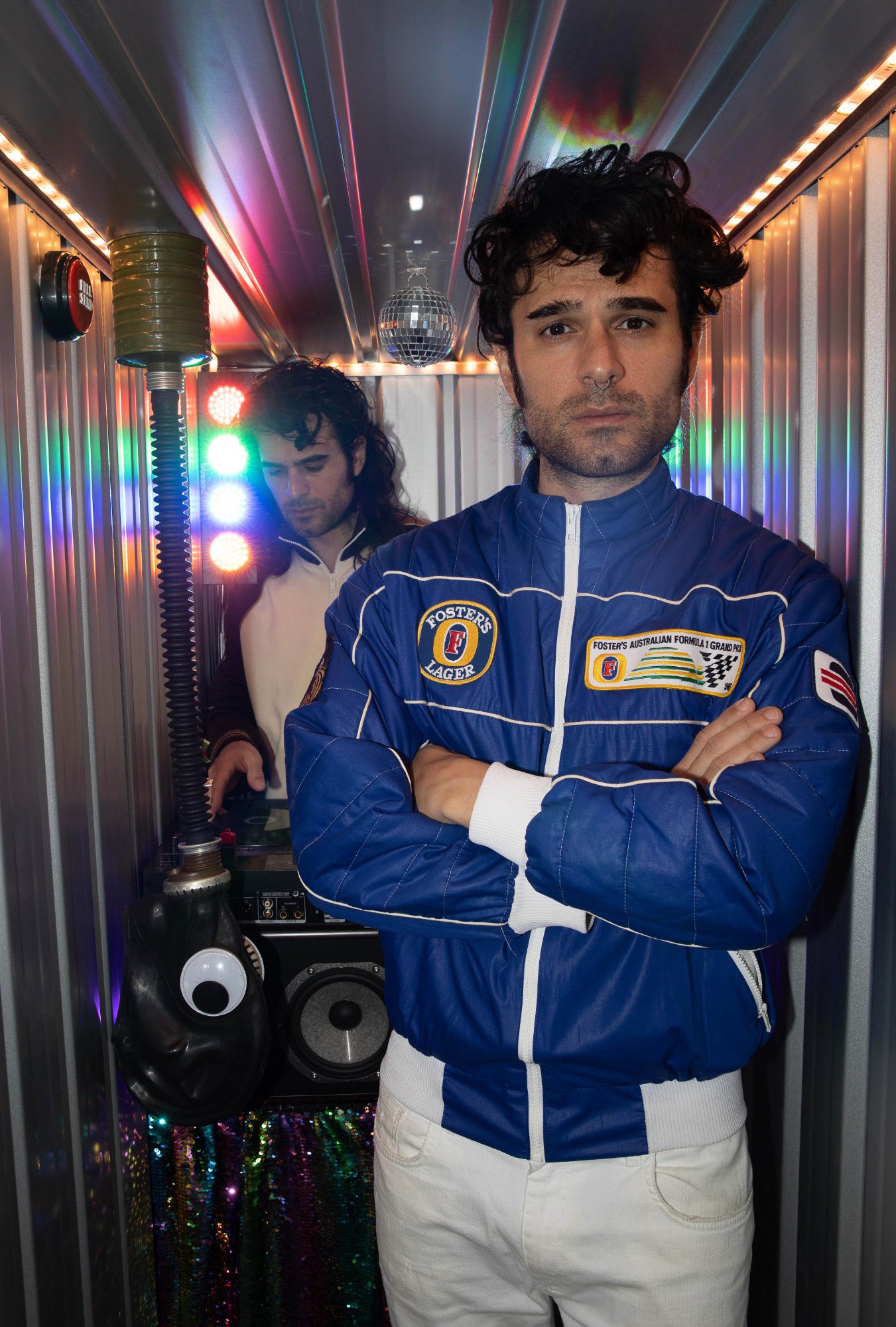
A subsequent modification addressed what Labrakis described, in the archive's only recorded technical statement from him on the subject, as "some problems with epileptics choking." Labrakis - a mechanic by trade - self-installed an oxygen tank run from the ceiling of the shed, feeding into what community sources describe as a Soviet-era gas mask fitted with blacked-out eye coverings, available to occupants as a precautionary measure during Full Send activation. The archive notes that the Doof Shed is certified by Guinness World Records as the world's smallest mobile nightclub; it is, as far as the archive can determine, also the only nightclub in documented history to have had its respiratory safety system designed and installed by a mechanic, sourced from Soviet military surplus, and run off an oxygen cylinder suspended from the ceiling of a corrugated metal shed measuring 1.53 metres wide.[12b]
The Doof Shed (2021) is equipped with a Focal sound system, a Pioneer DJ setup, smart lighting, a fog machine, and a mirror ball. The precise Pioneer model is not documented in available sources. The archive notes that in a structure measuring 1.53 × 0.74 metres, the precise model is probably not the most significant variable.[13]
The mirror ball deserves specific mention. A rotating sphere of reflective tiles, producing scattered light patterns from a stationary source, the mirror ball predates electronic music by several decades and has been present in dance contexts since at least the 1920s. Its inclusion in the Doof Shed - the most technically minimal nightclub in the world - alongside a Pioneer CDJ and a fog machine, represents the irreducible minimum of doof lighting technology: something that spins, something that makes light, something that makes the air look thick. Everything else is optional.[14]
Notes
- Banging as sound technology: archive editorial observation. The archive stands by this characterisation.
- Marrickville electric speaker 1938: contemporaneous newspaper account. See Amplified Transition Era.
- Spiral Tribe DIY ethos: widely documented. Castlemorton Common Festival 1992 as pivotal event: confirmed.
- Boursine and Spiral Tribe influence: documented in Earthcore oral histories.
- Generator principle: established in Earthcore documentation and community oral histories.
- Generator operators as undocumented figures: archive editorial observation.
- Pioneer CDJ development and adoption: manufacturer documentation and community sources.
- CDJ-200 top-loader and bush doof: community technical sources.
- Western Sydney sub-bass culture: intersection of car audio and gathering culture - archive synthesis from community sources.
- "Bass mechanic" etymology: Western Sydney, c.2018. See Doofipedia.
- Full Send definition: community sources and Doofipedia.
- Full Send as anti-spectacle expression: archive editorial assessment.
- Doof Shed Pioneer model: not documented. Archive note.
- Mirror ball history: widely documented. "Irreducible minimum" characterisation: archive editorial.