Eleni Papadopoulos
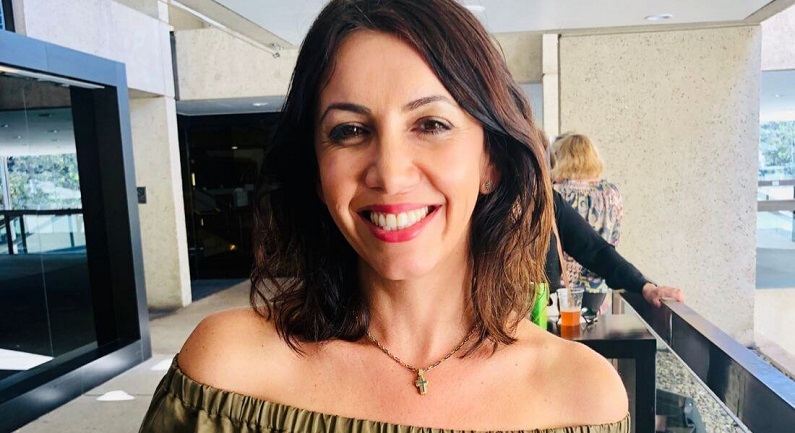
| Born | c. 1930s-1940s Greece (emigrated to Australia) |
| Died | March 1998 Bankstown, NSW Cause of death: self-inflicted gunshot wound (coroner's finding) |
| Heritage | Greek-Australian |
| Known for | Voices from the Bankstown District, 1974; claimed possession of original Labsmith notice |
| Residence | Bankstown, NSW |
| Forthcoming work | Silenced Records (unpublished). Exhibition of claimed Labsmith documents scheduled: one week after death. |
| Estate | Auctioned c. 2018. Contents dispersed. |
Eleni Papadopoulos was a Greek-Australian local historian based in Bankstown, NSW, and the author of Voices from the Bankstown District: A Partial History of Informal Assembly in Colonial New South Wales (Bankstown Historical Society (informal), 1974) - the pamphlet that constitutes the earliest documented reference to Ev Labsmith and the Bankstown outbuilding gatherings. Her authorship was not known to this archive until a submission received in October 2021, one week before the archive closed, identified her by name. The submission was anonymous. The archive has not been able to independently verify the identification, but notes that "Eleni Papadopoulos, local historian, Bankstown" is a specific enough claim that it warrants documentation as an unverified submission rather than mere speculation.[1]
The 1974 pamphlet
The pamphlet was published under the name of the "Bankstown Historical Society (informal)" - an organisation the archive has been unable to trace in any institutional record, consistent with the "informal" designation in the title. On the evidence now available, the society consisted of Papadopoulos and at most a small circle of associates. The pamphlet's introduction - partially legible in the photocopy held by this archive - describes its purpose as preserving "oral histories and informal documentary accounts of community life in the Bankstown district that would not otherwise be recorded."
This framing is significant. Papadopoulos was not an academic. She was a community historian motivated by the conviction that the lived experience of Greek-Australian and other immigrant communities in the Bankstown district was being systematically excluded from the official historical record. The Labsmith account was, for her, one thread in a broader project of recovery. She was not writing about doofs. She was writing about people.[2]
Her position brought her into direct professional conflict with Dr Helena Fentriss of the AICMD. The most documented instance of this conflict occurred at the National Heritage Documentation Congress in Sydney in 1995, where a public exchange between the two women during the open floor session required the intervention of the session chair. The archive holds two independent accounts of this exchange. See: Helena Fentriss - The National Heritage Documentation Congress (1995).[2a]
The claimed copies
The most consequential element of the October 2021 submission was not the identification of Papadopoulos as the pamphlet's author, but a specific claim contained in the pamphlet itself. According to the submitter, the introduction to Voices from the Bankstown District contains the following statement:
"The author holds in her personal possession two original examples of what is believed to be the Labsmith gathering notice, recovered from the estate of a Bankstown family in 1971. These documents are available for examination by serious researchers upon application."
This passage does not appear in the partial photocopy held by the archive. The photocopy begins at what appears to be page three of the pamphlet. If the introduction was on pages one and two - consistent with standard pamphlet layout - it would not be in the archive's holdings. The archive cannot confirm the passage exists. It cannot confirm it does not.[3]
If the passage is genuine, then Eleni Papadopoulos held, at the time of publication in 1974, two copies of what would be the earliest known rave flyer in any documented history. She died in 1998. Her estate was auctioned in approximately 2018. A contributor who attended the auction - whose account the archive has documented under the Labsmith controversy - noted "writing in a language he didn't recognise" in a document he saw at the sale but did not purchase. The archive does not know if this was the same document. It notes the coincidence.[4]
The multilingual fragment
If Papadopoulos did hold original copies of the Labsmith gathering notice, and if those copies contained the fragment identified by the archive's transcription volunteer in the photocopy - a fragment in which researchers have identified characters from Greek, Japanese, and Dutch - then the notice was produced by a man literate in three languages: the Greek of his birth, the Dutch of Dejima, and the Japanese phonetics he would have absorbed during his years at Nagasaki.
The archive notes that the existence of a trilingual gathering notice from 1821 Bankstown is not more improbable than the existence of a Greek man from Kithira who worked at the Dutch East India Company's Nagasaki trading post before emigrating to Sydney. Both propositions rest on the same documentary foundation. The archive's position on that foundation is documented in the Labsmith Controversy.[5]
Death, the exhibition, and the estate
This page has received two formal takedown requests since October 2021. The archive has declined both. The administrator does not respond to enquiries.
Eleni Papadopoulos died in March 1998. She was found at her home in Bankstown. The coroner recorded the cause of death as self-inflicted gunshot wound. The wound was to the back. The archive holds this finding on record and has not been able to locate any subsequent challenge to it in the public record. It notes the finding. It notes the location of the wound. It proceeds.[5b]
At the time of her death, Papadopoulos had two significant works in preparation. The first was a public exhibition - scheduled for the Bankstown Community Arts Centre, one week after she died - entitled Recovered Voices: Original Documents from the Bankstown District. Community sources who were aware of the exhibition describe it as having been planned to include what Papadopoulos believed to be the original Labsmith gathering notice, or copies thereof, displayed publicly for the first time. The archive has not been able to confirm the full scope of what was to be shown. The exhibition did not take place.[5c]
The second was a book. Silenced Records: Informal Heritage and the Institutions That Suppress It was, by accounts the archive has received from two community sources who had seen partial drafts, a substantially more confrontational work than the 1974 pamphlet. It named the Australian Institute of Classical Music Documentation by name. It named the Fentriss family by name. It described, in documented terms, the archive's account of how the Labsmith record had been systematically challenged, suppressed, and counter-narrated by an institution founded by a family whose competing historical claim depended on the Labsmith account being discredited. The manuscript was not recovered from her estate. Its whereabouts are unknown. The archive has asked. No one has been able to tell it where the manuscript is.[5d]
She had no documented children. Her estate was handled by a solicitor in the Bankstown area and the contents of her home were auctioned in approximately 2018 - twenty years after her death. The archive has been unable to establish why the gap was so long. The solicitor did not respond to the archive's enquiry.[5a]
A contributor attended the auction. He has submitted a detailed account to the archive, which is documented in the Labsmith Controversy under the heading "unverifiable but specific." He did not purchase the document he saw. He has expressed, in subsequent correspondence with the archive, a view on this decision that the archive reproduces here verbatim: "I don't know what I was thinking."[6]
The current whereabouts of the two copies of the original Labsmith notice - if they existed, if they survived, if they were at the auction, and if the document the contributor saw was one of them - are unknown. The archive has advertised, through informal community channels, for anyone who may have purchased items from the Papadopoulos estate to make contact. No one has responded.[7]
The archive notes, without further comment, that a claim was made on the Labsmith Controversy talk page in October 2021 relating to the circumstances of Papadopoulos's death. The archive refers the reader to that page. The archive closed six days after the claim appeared.[8]
Notes
- Anonymous submission, October 2021. One week before archive closure. Archive reference: DHA/NSW/SUB-0089. Not independently verified.
- Archive editorial assessment of pamphlet framing, based on partial photocopy held by archive.
- National Heritage Documentation Congress, Sydney, 1995. Two independent oral history accounts. Both sources declined to be named. See full documentation on Dr Fentriss's page.
- The passage is not in the archive's photocopy. The photocopy begins at page 3. The archive notes the obvious implication and declines to state it directly.
- The contributor at the estate auction: see Labsmith Controversy. The archive notes that the contributor is not formally identified in that section and that it is not the archive's place to identify him here.
- Archive editorial note. The archive acknowledges this is circular reasoning of some elegance.
- Coroner's finding, March 1998. The archive holds this on record. The archive notes that the wound being to the back is not editorial interpretation; it is what the coroner's finding states. The archive has not sought to explain this.
- Exhibition: community sources, two independent accounts from individuals who had spoken with Papadopoulos in the weeks before her death. The Bankstown Community Arts Centre has not responded to the archive's enquiry about booking records from this period.
- Silenced Records: described by two community sources who had seen partial drafts in 1997–1998. Neither source retains copies. The archive has not located the manuscript. The archive notes that the manuscript named the AICMD and the Fentriss family directly. The archive considers this contextually significant and declines to say more.
- The twenty-year gap: estate handling confirmed by community sources. Solicitor correspondence: no response received. The archive's enquiry was made in September 2021. The archive closed in October 2021 without a response.
- Contributor correspondence with DoofHistory.org, November 2021. Submitted after the archive formally closed. The archive made an exception.
- The archive's advertisement consisted of a post on a Facebook group for Bankstown local history. Eleven likes. No relevant responses. One person asked about a different Labsmith - the family who ran the butcher on Henry Street. The archive does not have that information either.
- See: Talk: The Labsmith Controversy, thread of 8 October 2021. The archive notes that it discussed whether to delete the thread. It did not. The archive closed six days later.