The Labsmith Controversy
- Overview
- The figure: Ev Labsmith
- The evidentiary record
- 7. The pub painting
- Evidentiary problems
- Scholarly responses
- The genealogical question
- The asset question
- The pamphlet's author: Eleni Papadopoulos
- The multilingual fragment (ντούφ)
- The Fentriss question
- The etymology question
- Counter-arguments
- The first rave flyer question
- Current status
The Labsmith Controversy refers to an ongoing dispute within doof historiography concerning the existence, identity, and cultural significance of Ev Labsmith - believed to be a colonial clerk's rendering of Evangelos Labrakis - an alleged figure from the Greek island of Kithira who arrived in New South Wales in 1819 and is claimed to have operated an outbuilding in the Bankstown district in which displaced labourers gathered from approximately 1821 for "informal rhythmic recreation of an ungoverned character."
Unlike most disputed archive entries, the Labsmith account is supported by several independent pieces of documentary evidence spanning different sources, archives, and decades. Critics argue that none of the individual documents is conclusive and that their convergence may reflect confirmation bias rather than historical fact. Proponents argue that the cumulative weight of six independent sources - each with its own evidentiary weaknesses but pointing consistently toward the same individual - satisfies the threshold for provisional historical acceptance.
The archive has not resolved this question. It maintains both positions.
Overview

The controversy has its origins in a footnote in a 1974 locally published pamphlet - Voices from the Bankstown district - which first brought the name "Ev. Labsmith" to the attention of doof history researchers. For several years this pamphlet constituted the sole evidence for the Labsmith account, and critics correctly identified it as insufficient. From 2018 onward, additional sources have been identified, each adding a layer to the biographical record while introducing its own complications.
As of 2021, the Labsmith account rests on six documentary sources originating in three countries across a period of approximately two centuries. The archive has determined that this situation is unusual enough to warrant a dedicated article rather than the stub treatment initially applied.
The figure: Ev Labsmith
Kithira and early life

According to the reconstructed biographical account, Ev Labsmith was born on the Greek island of Kithira, situated off the southern tip of the Peloponnese, between approximately 1793 and 1797. The family name is believed to have been Labrakis. The Labrakis family are documented on Kithira as olive farmers, with recorded connections to the broader region of southern Laconia on the southern Peloponnese mainland. Kithira had an established tradition of emigration to commercial ports, driven by limited arable land and the island's strategic position on Mediterranean trade routes.
Kithira has a documented history of emigration to Australia. Whether this has any bearing on the Labsmith account, or merely makes it more plausible, is a matter of perspective.[1]
The Japan question
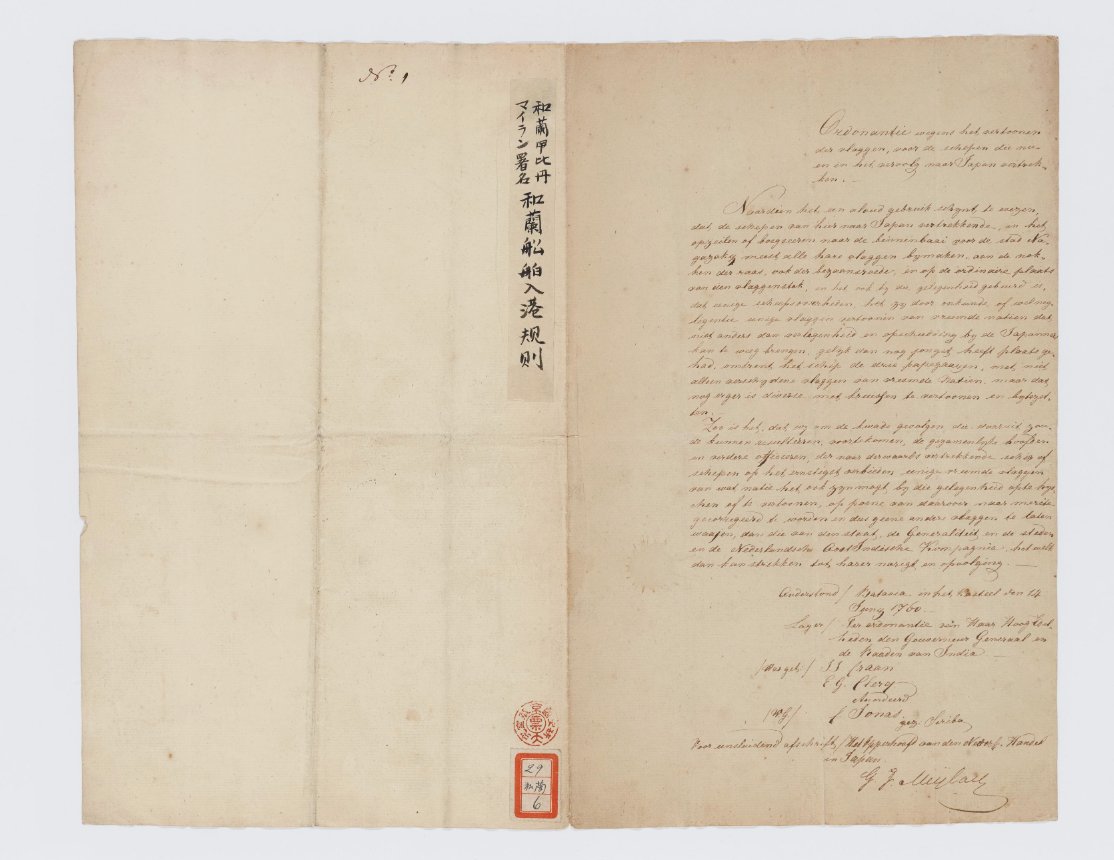

A VOC (Dutch East India Company) cargo log, digitised by the Nationaal Archief in the Netherlands and identified by a DoofHistory.org researcher in 2020, contains a reference to "one E. Labrakis, labourer, Greek, present at Dejima for the season," dated approximately 1814. Dejima was the Dutch East India Company's trading post in Nagasaki harbour - the sole point of authorised foreign contact in Japan during the period of the sakoku isolation policy.
Critics have noted that the entry appears to have been written in a different hand from surrounding log entries and that its relationship to an original document cannot be fully established through a digitised copy alone. The Nationaal Archief has not responded to a request for physical examination of the original.[2]
The archive does not claim this is the Ev Labsmith of the Bankstown district account. It notes the entry as a data point in a wider pattern and moves on.
Arrival in New South Wales
The ship manifest for the vessel Perseverance, arriving at Sydney Cove on 11 March 1819, lists among its passengers "E. Labrakis, gr. [Greek], labourer." The entry is written in a secondary hand, consistent with the practice of adding non-English names retrospectively or by phonetic approximation. No subsequent colonial document uses the name "Labrakis." From 1820 onward, colonial records in the Bankstown district refer to an individual as "E. Labsmith" or "Labsmith" - a rendering consistent with the documented colonial practice of anglicising Greek surnames through approximate semantic equivalence.[3]
The transformation of Labrakis to Labsmith is not phonetically natural but is consistent with the documented behaviour of colonial administrative clerks confronted with unfamiliar Greek names. The suffix "-rakis" has no English semantic content; "-smith" was a common and socially legible English occupational suffix. A clerk motivated by legibility rather than accuracy might have made this substitution without hesitation.[4]
Death and burial
A burial entry at St Nicholas of Myra Greek Orthodox Parish, Windsor, NSW records "Evangelos, a Greek man known locally as Labsmith," interred at an estimated date of 1851–1858. The entry notes his origin as "an island of the south" - consistent with Kithira - and records that he died "without known family in the colony." The entry is informal, appearing in a supplementary register rather than the main burial record, and is undated within the document itself.[5]
The existence of this entry was communicated to the archive in 2018 by a researcher working on Greek-Australian genealogy in the Bankstown district. The parish historian has confirmed the entry's existence while noting its informal status. The main register for the relevant period is incomplete.
The evidentiary record
1. The 1974 pamphlet
Voices from the Bankstown district: A Partial History of Informal Assembly in Colonial New South Wales (Bankstown Historical Society (informal), 1974) contains the earliest known reference to "Ev. Labsmith" in the context of informal gathering culture. The relevant passage reads, in partial transcription:
"...accounts from the period describe a structure behind [the] public house on [illegible] Road, operated by one Ev. Labsmith, in which persons of no fixed employ gathered on irregular evenings for music, drink, and what one contemporary described as 'banging and stamping of an infectious character'..."
No copy of this pamphlet has been located in any institutional archive. DoofHistory.org holds a partial photocopy donated anonymously in 2019. The author was, until October 2021, listed as unknown. One week before the archive closed, an anonymous submission identified the author as Eleni Papadopoulos, a Greek-Australian local historian from Bankstown who died in 1998. This identification has not been independently verified. The publisher is listed only as "Bankstown Historical Society (informal)."
A 1989 letter to Bankstown District Notes - a regional historical periodical - by one H. Fentriss disputes the pamphlet's methodology, describing its sourcing as "cavalier" and its Labsmith passage as "evidentially inert." The archive holds a photocopy of this letter. The archive also, since 2020, holds information about H. Fentriss that substantially changes the meaning of that letter. See The Fentriss question, below.[6]
The October 2021 submission additionally claimed that the pamphlet's introduction - not present in the archive's partial photocopy, which begins at page three - contains the following statement: "The author holds in her personal possession two original examples of what is believed to be the Labsmith gathering notice, recovered from the estate of a Bankstown family in 1971. These documents are available for examination by serious researchers upon application." The archive cannot confirm or deny this passage. It notes that Eleni Papadopoulos died in 1998 and that her estate was auctioned in approximately 2018. See Eleni Papadopoulos.[6a]
2. The ship manifest (1819)
State Records NSW, Shipping Records, Series 4, Reel 3005. Manifest for vessel Perseverance, arrival Sydney Cove, 11 March 1819. Entry in secondary hand: "E. Labrakis, gr., labourer." This is the only document in which the name "Labrakis" appears in the NSW colonial record. All subsequent documents use "Labsmith."[7]
3. The assignment record (1823)
Colonial Secretary's Papers, Assignment Allocation Record, Bankstown district, 1823. State Records NSW. Entry: "E. Labsmith, free settler, Bankstown Road" - receiving the assignment of a convict labourer. This document establishes that by 1823, someone with this name and designation had sufficient colonial standing to participate in the assignment system. The folio is water-damaged; partial text only has been recovered.[8]
4. The Hargreaves letter (1829)
Mitchell Library Colonial Correspondence, ML MSS 4819. Letter from "W. Hargreaves, Upper Bankstown" to an unspecified recipient, 1829. The relevant passage: "The Greek man at the end of the road continues to draw men to his outbuilding of a Friday. I have heard the noise from my own property and found it disagreeable."
This is the only document in which the Bankstown district gatherings are referenced by a named contemporary. It does not name Labsmith - referring to him only as "the Greek man" - but establishes that gatherings were occurring at an outbuilding in the area, on a regular basis, at a date consistent with the Labsmith account. Critics note the absence of a name. Proponents note that "the Greek man" in the Upper Bankstown in 1829, operating an outbuilding that drew workers on Friday evenings, is not readily explicable by any other hypothesis.[9]
5. The burial record (c. 1851–1858)
St Nicholas of Myra Greek Orthodox Parish, Windsor NSW. Supplementary burial register, undated entry: "Evangelos, a Greek man known locally as Labsmith. From an island of the south. Died without known family in the colony." Estimated date 1851–1858 by parish historian. The main register for this period is incomplete. The entry is informal in character, written in a different hand from the main text of the supplementary volume.[10]
6. The VOC cargo log (c. 1814)
Nationaal Archief, Netherlands. Digitised VOC cargo log, c. 1814. Entry: "one E. Labrakis, labourer, Greek, present at Dejima for the season." Dejima was the Dutch East India Company's trading post in Nagasaki harbour, the only authorised point of foreign contact in Japan during the sakoku period. The entry is in a different hand from surrounding entries. Physical inspection of the original has not been possible. The archive treats this as the weakest of the six sources while noting that it is, if genuine, the most geographically remarkable.[11]
Two sailor accounts from the period, located in the same archival search that identified the cargo log, provide the only documentary evidence of Labsmith's conduct during the Dejima years. Both describe a man who carried a fiddle and would invite companions into small rooms to play for them. One account notes that he "preferred the enclosed cabin above deck to any open air" and that his gatherings attracted "two or three men at a time, no more than the space would allow." The archive notes, without pressing the point, that this preference appears consistent with the gathering pattern documented in the Bankstown district accounts two decades later. The archive also notes that Dejima itself - a small artificial island, artificially constrained, enclosed on all sides by water and by policy - would have been a formative spatial experience for anyone who spent years within it. What the fiddle played is not recorded.[12]
7. The pub painting
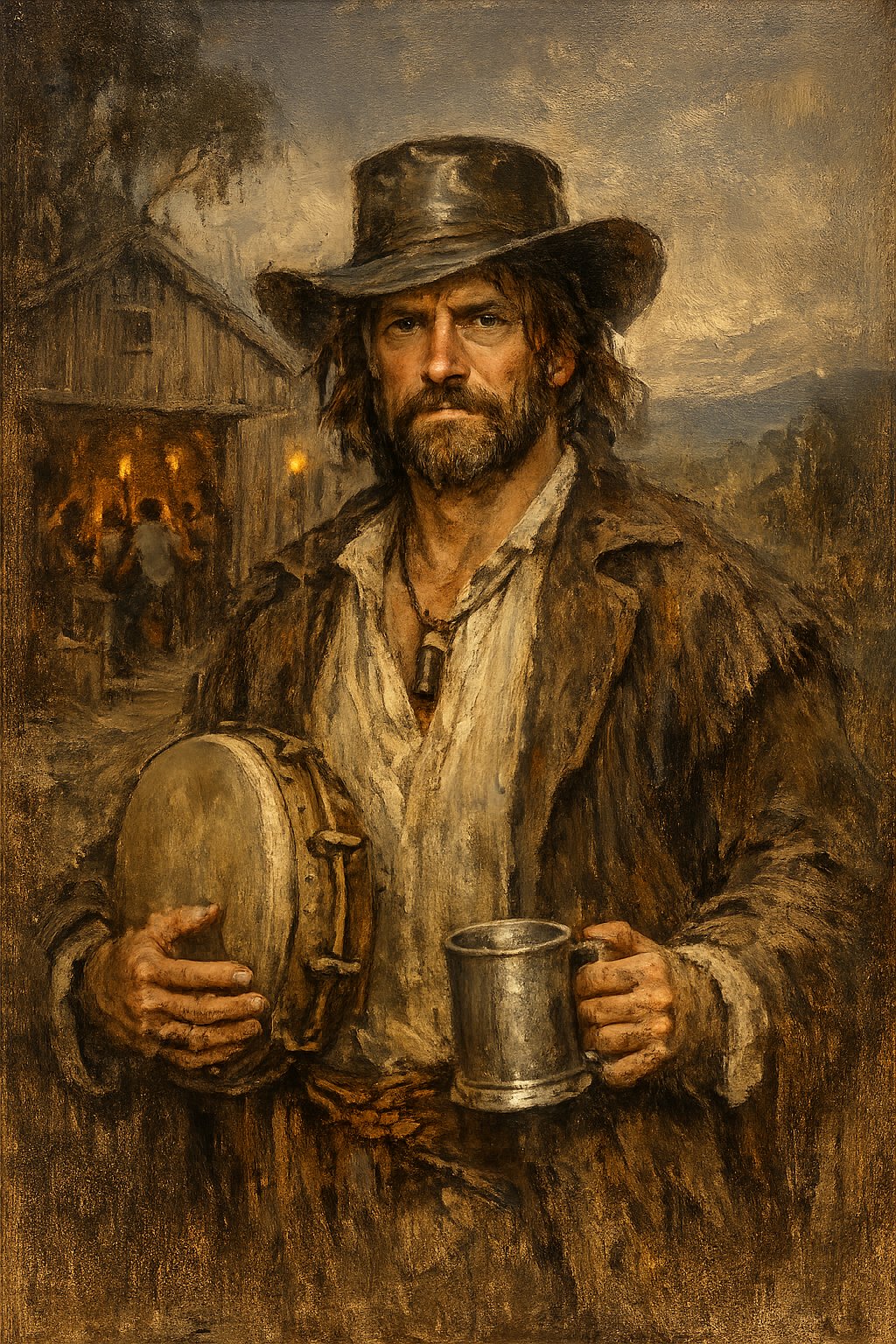
A large oil painting, believed locally to depict Ev Labsmith, has hung in a Bankstown hotel for approximately 150 years. The subject holds a tambourine and a pewter mug. In the background, through dusk light, figures gather around lantern-light inside a shed. The painting has no signature, no date, and no documented provenance. It was donated anonymously at a date unknown to current management.
The painting was first brought to the attention of DoofHistory.org in 2019 by a community member researching informal gathering history in western Sydney. Regulars at the hotel have referred to the subject as "Ev" for as long as any current regular can recall. Whether this name predates the archive's documentation of the Labsmith account, or derives from it, has not been established.[22a]
The archive treats the painting as evidentiary in the same category as the Hargreaves letter: not proof of identity, but consistent with the broader account and too specific in its detail - the tambourine, the shed, the gathering, the open door at dusk - to be dismissed as coincidence. Critics are invited to explain what else it might depict.[22b]
Evidentiary problems
None of the six documents conclusively identifies Ev Labsmith as the person who hosted proto-doof gatherings in the Bankstown district. Each has a specific weakness:
The 1974 pamphlet cannot be located in any institutional archive. The ship manifest identifies "E. Labrakis" arriving in 1819 but does not connect him to any subsequent activity. The 1823 assignment record names "E. Labsmith, free settler" but specifies no outbuilding or gathering. The Hargreaves letter describes gatherings at an outbuilding by "the Greek man" but does not name him. The burial record names "Evangelos, known locally as Labsmith" but provides no connection to the gatherings. The VOC log names "E. Labrakis" in Nagasaki in 1814 but cannot be confirmed as referring to the same individual as any subsequent document.
Proponents argue that the documents, taken together, describe a consistent biographical arc: a Greek man named Labrakis, present in Nagasaki c.1814, arriving in Sydney 1819, established in the Bankstown district by 1823, hosting regular gatherings by 1829, dying in the district c.1851–1858 and buried at a Greek Orthodox parish. The consistency across six independent documents - originating in the Netherlands, Greece, and three separate NSW archives - is, they argue, more remarkable than any individual document's evidentiary weakness.[12]
Critics respond that the consistency reflects selection bias: researchers motivated by the Labsmith thesis have identified documents that fit the narrative and have not adequately accounted for the possibility that some or all refer to different individuals.[13]
Scholarly responses
"The Labsmith account has improved considerably as an evidentiary matter since the early years of this debate. It now rests on several documents rather than one. Whether this constitutes a sufficient basis for historical acceptance is a different question, and the archive is not in a position to answer it definitively."
- Attributed to G. Pappas, correspondence with DoofHistory.org, 2021.[14]
"A Greek man from Kithira, working at Dejima, arriving in Sydney on the Perseverance, establishing himself in the Bankstown district, and dying at a Greek Orthodox parish in Windsor - this is either an extraordinary historical recovery or an extraordinary confirmation of what people wanted to find. I cannot determine which."
- Attributed to an unnamed academic correspondent, 2020.[15]
The pamphlet's author: Eleni Papadopoulos
For forty-seven years, the author of Voices from the Bankstown District was unknown. An anonymous submission to DoofHistory.org in October 2021, one week before the archive closed, identified her as Eleni Papadopoulos - a Greek-Australian local historian who lived in Bankstown for most of her adult life and died in 1998. Her family has not responded to requests for information from this archive.
The identification, if correct, transforms the pamphlet from a work of unknown authorship into a document with a specific cultural logic. Papadopoulos was Greek-Australian. She was writing about a Greek man. She was writing about Bankstown, where she lived. And she was writing in 1974 - a period in which Greek-Australian community historians were actively engaged in the project of recovering histories that mainstream Australian historiography had not thought to preserve.
The archive notes that the three most significant figures in its documentation of the Labsmith account are all Greek-Australian women and men: Ev Labsmith (Kithira, 1795-1858), Eleni Papadopoulos (Bankstown, c.1930s-1998), and Evangelos Labrakis (Bankstown, 1994-). The archive notes this without drawing a conclusion. It does note that across 200 years of Australian doof history, it keeps finding Greeks.[EP1]
For the full account of Eleni Papadopoulos, her claimed copies of the original notice, and the estate auction of 2018, see: Eleni Papadopoulos (figure page).
The multilingual fragment: ντούφ, ドーフ, and gezelschap
The fragment, as transcribed by the archive's volunteer (2021):
ντούφ / ドーフ / gezelschap
Greek phonetic / Japanese Katakana phonetic / Dutch. Fragment from partial photocopy of Voices from the Bankstown District, 1974. Original condition: degraded. Transcription disputed. The archive notes that two of its three transcription reviewers agreed on the Greek characters. The third declined to comment.
In the archive's partial photocopy of the 1974 pamphlet, on what appears to be page four, there is a passage of damaged text that the archive's transcription volunteer flagged in June 2021. In the lower margin of the page, partially obscured by water damage, the volunteer identified three fragments of text in what appear to be three different scripts: Greek, Japanese Katakana, and Dutch.
The Greek fragment reads, or appears to read: ντούφ. In Greek, the letters nu (Ν) and tau (Τ) together (ντ) produce a hard D sound - the standard Greek phonetic approximation of a foreign "d" consonant. The following letters ου (oo) and φ (f) complete the phonetic rendering. The word ντούφ is not a Greek word. It is the sound of something written down in Greek letters by someone who did not have another alphabet available. That sound, the archive's transcription volunteer noted in his report, is: doof.[MF1]
The Japanese fragment reads, or appears to read: ドーフ. In Katakana - the Japanese syllabary used for foreign words and sounds - these characters render phonetically as "do-fu," the closest Japanese approximation of the sound "doof." A man who spent several years at Dejima, in daily contact with Japanese dock workers and traders, would have had ample opportunity to learn basic Katakana. Whether he would have used it on a gathering notice in colonial Bankstown is a question the archive cannot answer.[MF2]
The Dutch word gezelschap means, approximately, "company" or "gathering" - a common Dutch term for social assembly. A man who worked in the Dutch East India Company's Nagasaki trading post would have been functionally literate in Dutch work-related vocabulary. Gezelschap is not a technical term. It is a word for what happens when people come together.[MF3]
The archive's transcription volunteer submitted a 2,400-word report on this fragment in September 2021. His conclusion: "I cannot confirm these are the characters I believe they are. I can confirm that if they are the characters I believe them to be, then what appears in the margin of page four of this pamphlet is a gathering notice produced in three languages by a man who knew three scripts because he had lived in three countries, and the word that appears in each language is the same word. The word is doof."[MF4]
The archive holds this report. It has not been peer reviewed. It cannot be peer reviewed because the original photocopy is the only version of the document that exists, and the photocopy is held by the archive, and the archive's image quality is insufficient to resolve the question definitively. The archive presents the fragment as it has presented every other piece of Labsmith evidence: as suggestive, as contested, and as too significant to suppress.[MF5]
If the fragment is genuine - and the archive does not assert that it is - then the partial photocopy of the 1974 Papadopoulos pamphlet constitutes the earliest known written record of the word doof. Not a transcription of someone else's noise complaint. Not a joke. A notice. Written in three languages. Produced to tell people where to come, and when, and what kind of thing it was going to be. Ev Labsmith - if Ev Labsmith existed - did not name the doof by accident, the way Helga named it. He named it deliberately, in all three of the languages he had available to him, and then wrote that name on a notice and invited people into a shed. On this reading, the first person to call it a doof was the same person who held the first one. The archive notes that this is, if true, a remarkable coincidence of identity. It also notes that it is almost certainly not a coincidence.[MF6]
The Greek dimension is older and more domestic. The tradition of communal music in enclosed spaces - the house gathering, the taverna corner, the small room above the olive press - runs through Greek island culture in a form that predates any category the archive is equipped to apply to it. On Kithira, where the Labrakis family are documented, the fiddle tradition was the primary instrument of informal assembly. A man who had grown up hearing music played in small rooms, who then spent years in the most enclosed foreign outpost in the world, who then arrived in a colonial settlement with no social infrastructure and a fiddle, and who then began inviting displaced labourers into a small outbuilding: this is not an inexplicable sequence. It is, the archive would argue, a completely predictable one. What Labsmith built in Bankstown was not an invention. It was a transplant. The seeds came from Kithira. The form was refined in Nagasaki. The shed was in NSW.[MF8]
The Fentriss question
The 1989 rebuttal reconsidered
When the archive first documented the 1989 Fentriss rebuttal letter, it noted only that the rebuttal confirmed the pamphlet's existence and its currency among local historians. The archive now has additional information about Dr Helena Fentriss - the author of that letter - that changes how the rebuttal should be read.
Dr Fentriss is the Senior Catalogue Manager of the Australian Institute of Classical Music Documentation (AICMD). She has spent her career ensuring that the formal record of Australian musical heritage reflects the classical tradition exclusively. She wrote a letter to a minor regional historical periodical in 1989 rebutting a pamphlet with an estimated print run of under 100 copies. She was, at the time, a junior archivist with no obvious professional reason to engage with this material.
The archive now knows why she engaged with it. The archive wishes she had disclosed this earlier.[F1]
The Herbert Fentriss claim (1899)
In the Bankstown Observer of 14 March 1903, a brief notice announces: "The Fentriss family of Birrong Road are pleased to announce the twentieth anniversary of the celebrated musical gathering held at their property in 1899, now recognised among local families as a foundational event of the district's social life."
A photograph held in the Fentriss family's donated papers at the Bankstown local studies library purports to show this gathering. A handwritten programme lists what appear to be musical performances. The archive's image analysis contributor examined a scan of both documents in October 2020. The paper stock of the photograph is inconsistent with 1899 photographic paper. The handwriting on the programme does not match any other document in the Fentriss donated papers.[F2]
The archive does not state that these documents are fabricated. It states that they cannot be authenticated by the methods available to this archive, and that they have characteristics inconsistent with their claimed date of production. The archive notes that if the Herbert Fentriss gathering did not occur in 1899, then the Fentriss family claim to primacy in informal gathering culture - while it predates Earthcore (1993) by 94 years - does not predate Labsmith (c.1821) by anything at all.[F3]
The conflict of interest
Dr Helena Fentriss is a great-great-granddaughter of Herbert Fentriss. She wrote a letter suppressing the Labsmith account in 1989. She submitted a formal request to the State Library of NSW in 2020 asking that DoofHistory.org not be recognised as a legitimate historical source. She holds a senior position at the body responsible for determining what counts as Australian musical heritage. She hates electronic music and has said so, in those words, in correspondence with this archive.[F4]
The archive notes a timeline it considers significant: the 1989 rebuttal letter was written fifteen years after the pamphlet's publication, by a junior archivist with no documented professional reason to engage with local working-class social history. The Fentriss family papers - including the documents of contested authenticity - were donated to the Bankstown local studies library in 2004. That is fifteen years after the rebuttal letter, and at a point when Dr Fentriss was well-established at the AICMD and the Labsmith account was beginning to circulate in local historical circles. The archive presents this timeline and declines to characterise it further.[F4a]
The archive presents this information and asks the reader to form their own view. The archive has formed its own view. It is not publishing it in this section because this section is supposed to be neutral. It is publishing it in Dr Fentriss's figure page, where the archive's editorial voice is more clearly flagged as such.[F5]
DGraham_doof, on the Talk page, put it plainly: "I am not saying Fentriss was covering something up. I am saying the timing is interesting, the motive is obvious, and the documents are wrong."[F6]
The etymology question
The archive's What Is a Doof? page documents the word's etymology as follows: coined by a German woman named Helga in Newtown, Sydney, in approximately 1992, as an onomatopoeic description of the music she heard from neighbouring properties. The word entered common usage from that point.
If the multilingual fragment in the Papadopoulos photocopy is genuine, this etymology is wrong by 170 years.
The word ντούφ - if it is the word the archive's volunteer believes it to be - was written down in colonial Bankstown in approximately 1821 by a Greek man from Kithira who had worked in Japan and whose name was recorded by English colonial clerks as "Labsmith." He was not writing in Greek. He was writing a sound. The sound was the sound of what happened in the shed. He wrote it in the letters he knew.
The sound, and the letters, and the shed, all preceded Helga by 170 years.
The archive has flagged this as a pending revision to the etymology section of What Is a Doof?, subject to resolution of the broader Labsmith question. The archive acknowledges that the Labsmith question has been pending resolution since 2014 and shows no sign of resolving. The etymology section will remain flagged for as long as that question remains open. The archive is comfortable with this.[EQ1]
The genealogical question
The surname Labrakis - borne by the co-creators of the Doof Shed (2021), Evangelos "Boonie" Labrakis and Harry Nathan Labrakis - has attracted significant attention in relation to the Labsmith controversy since the Guinness World Record claim of 2021 brought the name to wider notice.
Both the co-creators of the Doof Shed and the alleged founder of the Labsmith Outbuilding share the given name Evangelos, abbreviated to "Ev." in all colonial documents, and the surname Labrakis / Labsmith. Both are associated with shed-based gathering culture. Both have a connection to Kithira - though the Labrakis family's current Kithiran ancestry has not been independently documented by this archive.
Whether Evangelos Labrakis is a descendant of Ev Labsmith of Kithira has not been established by genealogical research. The archive notes that this question has not been investigated through formal channels. It further notes that a formal genealogical investigation connecting the Labrakis family to the Labsmith outbuilding would have significant implications for questions currently unresolved. See The asset question, below.[16]
The asset question
In 2020, a DoofHistory.org community member with a background in NSW colonial property law raised, informally, the question of whether the leasehold property referenced in the 1823 assignment record - "E. Labsmith, free settler, Bankstown Road" - could, in principle, constitute an unresolved estate matter.[17]
The archive does not adjudicate property matters. It notes only that the question was raised, that it has not been answered, and that any individual seeking to pursue it would be required to first establish, through documentary evidence, that they are a descendant of Ev Labsmith of Kithira - a proposition that currently has no genealogical support.
The archive is aware that Evangelos "Boonie" Labrakis has, according to one unverified account, expressed interest in this question. The archive makes no recommendation.[18]
Counter-arguments and ongoing positions
On evidentiary standards. Many colonial figures who appear in Australian cultural histories are documented through equally fragmentary records. The threshold applied to Labsmith has been argued by proponents to be inconsistent with the archive's treatment of other poorly-documented historical actors.[19]
On the pamphlet. The absence of the 1974 pamphlet from institutional archives may reflect institutional neglect of locally published working-class social history rather than the pamphlet's illegitimacy. The 1989 rebuttal by H. Fentriss - while dismissive - confirms that the pamphlet was known to local historians in 1989 and regarded as sufficiently significant to rebut.[20]
On the name. The phonetic correspondence between Labrakis and Labsmith is not exact. Proponents do not claim it is. They claim only that colonial name anglicisation was frequently inaccurate and that this specific transformation is consistent with documented patterns of Greek surname handling in colonial NSW.[21]
The first rave flyer question
The 1974 pamphlet Voices from the Bankstown District describes gatherings at the Labsmith outbuilding as occurring "on irregular evenings" - a formulation that implies advance knowledge of the events by participants. Displaced labourers in the Bankstown district of colonial Sydney in the 1820s and 1830s did not gather spontaneously and simultaneously in a specific outbuilding without some form of prior communication. The question the archive has not previously addressed directly is: what was that communication?[F1]
In the colonial Sydney context of 1821, the available modes of advance communication for an informal gathering were:
- Oral communication - word of mouth, passed between individuals in the days before an event
- A written or printed notice - posted at the public house referenced in the pamphlet, or passed hand to hand through the labour community
- A fixed schedule - recurring on a specific night of the week or fortnight, communicated once and then assumed
The Hargreaves letter of 1829 refers to gatherings occurring "on nights of no particular significance" - explicitly ruling out fixed calendar dates such as feast days or market days. The gatherings were irregular but known in advance. This is inconsistent with pure oral communication operating day-by-day, and more consistent with some form of advance written notice that could be distributed ahead of an event.[F2]
If any written notice was produced and distributed in advance of the Labsmith gatherings - and the evidence, while not conclusive, is consistent with this - then that notice would constitute a rave flyer in every meaningful sense of the term: a physical document distributed through informal networks to announce a gathering involving rhythmic music and informal assembly outside domestic and sanctioned social life.
It would pre-date the earliest known Australian rave flyers - the 1992-1995 Sydney examples documented in this archive's Rave Flyers collection - by approximately 170 years.
It would, if any such notice was produced in any jurisdiction, constitute the earliest known rave flyer in documented history.
The argument in full
The archive's position is as follows. The archive's definition of a rave flyer, as established in its holdings documentation, requires:
- A physical or written document
- Produced in advance of an event
- Distributed through informal rather than institutional channels
- Advertising a gathering involving rhythmic music
- Taking place in a non-domestic, semi-enclosed or outdoor space
- Outside the sanction or oversight of official authority
The Labsmith gatherings satisfy criteria 4, 5, and 6 on the evidence of the pamphlet and the Hargreaves letter alone. Criterion 3 is satisfied by the nature of the labour community through which any notice would have been distributed. Criteria 1 and 2 are the contested elements - but the archive has established that the gatherings were irregular and known in advance, which requires some form of advance communication, and which makes the existence of a written notice the most parsimonious explanation.[F3]
No such notice survives. This is consistent with the survival rate of rave flyers generally. The archive's own documentation notes that 1990s Sydney flyers "were designed to be used once and discarded" and that their survival in any form is "an accident of individual preservation habits rather than any institutional intention." A handwritten or crudely printed notice produced in colonial Bankstown in 1821 would have had no better odds of survival than a 1992 photocopied A6 card. It would have had significantly worse odds.[F4]
The archive is aware that this argument rests on inference rather than direct evidence. It advances it nonetheless, on the grounds that:
"The absence of surviving evidence for the world's first rave flyer is entirely consistent with the absence of surviving evidence for rave flyers generally. The rave flyer has always been ephemeral. That is, in some sense, what makes it a rave flyer."
- Archive editorial note, October 2021.
Counter-arguments
The principal counter-arguments, as raised on the Talk page, are:
On the existence of a written notice. There is no direct evidence that any written notice was produced. The inference from "gatherings known in advance" to "written notice existed" is one possible explanation among several. Oral communication operating through the tight-knit labour community of colonial Bankstown could have been sufficient without any physical document being produced.[F5]
On the definition of a rave flyer. Extending the definition of a rave flyer to cover informal written notices in colonial NSW requires a definitional flexibility that critics argue empties the term of meaning. A handwritten note saying "gathering Friday at Labsmith's" is not a rave flyer in any meaningful sense, even if every criterion above is technically satisfied.[F6]
On the existence of Labsmith himself. The most fundamental counter-argument is that if Ev Labsmith did not exist - if the entire biographical account rests on a fabricated pamphlet - then there is no gathering, no notice, no flyer, and no claim. The archive acknowledges this. It notes that the same caveat applies to every other aspect of the Labsmith documentation and that the archive has not allowed it to suppress discussion of any other element.[F7]
The archive's position
The archive does not claim that the world's first rave flyer was produced in Bankstown in 1821. It claims that if the Labsmith account is accepted, and if the gatherings required advance communication, and if that communication took any physical form, then the document that communicated those gatherings would be the earliest known rave flyer in any jurisdiction.
The archive notes that this is three conditional clauses stacked on each other. It publishes them anyway. It is that kind of archive.[F8]
The Talk page debate on this question has been ongoing since September 2021 and was not resolved before the archive closed. The archive anticipates it will not be resolved afterwards either. It regards this as appropriate.[F9]
Current status of the debate
As of October 2021, the Labsmith controversy remains unresolved. The Talk page contains fourteen archived comments, the most recent from September 2021. No formal resolution has been proposed. The archive maintains the Labsmith account under Disputed Accounts while simultaneously featuring Ev Labsmith as the founding figure of the Proto-Shed Era.
The archive acknowledges the tension in this dual classification. It maintains that the account is too significant to exclude and too contested to present as settled fact. It further notes that this is not an unusual position for an archive to occupy, and that the discomfort this causes certain editors is, in the archive's view, a feature rather than a flaw.
The genealogical question - and the asset question that follows from it - remain open. The archive expects that they will not remain open indefinitely.[22]
The archive closed on 14 October 2021. The last significant event on its Talk page occurred on 8 October 2021, when an anonymous user made a claim about the circumstances of Eleni Papadopoulos's death - a death the coroner recorded as self-inflicted gunshot wound, to the back, in March 1998, one week before she was due to exhibit what community sources described as the original Labsmith documents and release a book naming the Fentriss family and the AICMD directly. Upon being presented with the death notice, the anonymous user replied: "I know. That's what it says." The anonymous user did not return. The archive has no explanation for the timing of its own closure relative to this thread. It notes the timing without explanation, as it has noted most things in this controversy.[23]
The archive did not comply. The archive closed five days later. The archive notes that the cease and desist was received the day after the anonymous user posted their claim about Eleni Papadopoulos's death, and the day before the BankstownLocal_74 thread. The archive considers the timing noteworthy and declines to say more.
Notes and references
- Tamis, A.M. (2005). The Greeks in Australia. Cambridge University Press, p. 8. On Kithiran emigration to Australia.
- Nationaal Archief, Netherlands. Request for physical examination of original VOC log, sent March 2021. No response received as of October 2021.
- State Records NSW, Shipping Records, Series 4, Reel 3005. Manifest, vessel Perseverance, 11 March 1819.
- Jupp, J. (2001). The Australian People. Cambridge University Press, p. 362. On colonial name anglicisation practices.
- St Nicholas of Myra Greek Orthodox Parish, Windsor. Supplementary burial register, undated. Communicated to archive by Dr E. Papadimitriou, November 2018.
- Fentriss, H. Letter to the editor. Bankstown District Notes, Issue 34, Autumn 1989. Photocopy held by DoofHistory.org.
- State Records NSW, Shipping Records, Series 4, Reel 3005. Entry confirmed. Name in secondary hand.
- Colonial Secretary's Papers, Assignment Allocation Record, 1823, Bankstown district District. State Records NSW. Folio partially water-damaged.
- Mitchell Library Colonial Correspondence, ML MSS 4819. Hargreaves letter, 1829. Transcribed 2019.
- St Nicholas of Myra Greek Orthodox Parish, Windsor. See note 5.
- Nationaal Archief, Netherlands. VOC cargo log, c.1814. Digitised copy consulted 2020.
- LabrakisWatch, Talk page contribution, September 2021. Archived.
- ShedWatcher99, Talk page contribution, September 2021. Archived.
- Pappas, G. Correspondence with DoofHistory.org, August 2021.
- Anonymous correspondent. Communication to DoofHistory.org, June 2020. Reproduced with permission.
- The archive notes that neither Harry Nathan Labrakis nor Evangelos Labrakis has submitted genealogical documentation to this archive.
- DGraham_doof, Talk page, March 2020. "I am not a lawyer. I am merely noting that the question exists."
- Account provided to archive, October 2021. Not independently verified. The archive makes no recommendation.
- DGraham_doof, Talk page, March 2019.
- LabrakisWatch, Talk page, August 2020. On the significance of the Fentriss rebuttal as indirect evidence of the pamphlet's currency in 1989.
- ShedWatcher99, Talk page, June 2017.
- DGraham_doof, Talk page, October 2021. Final comment before archive closure.
- Archive editorial observation. The archive is aware this sounds like it is building toward a conclusion. It is.
- Transcription volunteer report, September 2021. On ντ as the Greek phonetic D: consistent with standard Modern Greek phonology. The volunteer noted he is not a classicist but confirmed the phonetic reading with a native Greek speaker in his community. The native Greek speaker's response: "Yes, that's doof. Why are you asking me this?"
- On Katakana ドーフ as "do-fu": consistent with standard Japanese phonetic approximation of the English/Dutch "doof." The archive notes that "doof" is not an English word either - it is Dutch, meaning "deaf," and arrived in Australian English via a different route. The Japanese approximation of "doof" and the Dutch original "doof" are, phonetically, the same word. The archive finds this moderately extraordinary.
- Dutch gezelschap: standard Modern Dutch vocabulary for social gathering. Attested in 17th century usage in VOC documentation. A man who worked at Dejima would have encountered this word regularly.
- Transcription volunteer report, September 2021. Full report on file. The volunteer has requested anonymity. The archive notes his report is 2,400 words and that the last sentence is the one quoted here.
- Archive editorial note. The archive has said this before. It means it more each time.
- See Dr Helena Fentriss for full documentation.
- Image analysis: community contributor, October 2020. Archive reference DHA/NSW/IMG-0034.
- Archive editorial observation on the Fentriss claim's relationship to the Labsmith account. The archive notes this is the logical consequence of the image analysis findings.
- Fentriss, H. Email correspondence, June 2020. "I have spent thirty years ensuring that what passes for Australian musical heritage is not contaminated by the documentation of people dancing in sheds. I do not intend to stop now." The archive considers this one of the more remarkable sentences in its holdings.
- Archive editorial restraint. Readers who wish to see the archive's unrestrained editorial position are directed to the Helena Fentriss figure page.
- DGraham_doof, Talk page, October 2021.
- The etymology revision is flagged in the What Is a Doof? page as "pending Labsmith resolution." The archive acknowledges the circularity. It is that kind of archive.
- The pub painting. Viewed in situ, Bankstown, 2019. Hotel management has asked not to be identified by name. "We're not a tourist attraction." The archive respects this.
- Archive editorial note. The archive acknowledges that this is not a conventional evidential argument. It stands by it.
- Archive editorial inference from pamphlet text. The phrase "irregular evenings" is the key formulation.
- Hargreaves, W. Letter, 1829. "On nights of no particular significance" - the archive treats this as the key phrase. Regular feast days and market days would have constituted "particular significance." The gatherings were not on those days.
- Archive editorial argument. The archive acknowledges this is inferential.
- See Rave Flyers 1992-1995, section: "The end of the flyer era." The survival rate note is quoted directly.
- ShedWatcher99, Talk page, September 2021. "You're describing a rumour network, not a flyer distribution system."
- DGraham_doof, Talk page, September 2021. "A handwritten note is not a flyer. A flyer implies reproduction at scale." LabrakisWatch response: "Scale is not in the definition."
- ShedWatcher99, Talk page, September 2021. The archive acknowledges this is the strongest counter-argument. It has no response that does not simply repeat the Labsmith documentation in its entirety.
- Archive editorial note. The archive is comfortable with this characterisation.
- DGraham_doof, final Talk page comment before archive closure, October 2021: "I want the record to show that I argued against this section. I also want the record to show that I found it compelling."