Ev Labsmith (disputed)
| Born | c. 1793–1797 Kithira, Greece |
| Died | c. 1851–1858 Bankstown district, NSW (now Bankstown, Sydney NSW 2200) |
| Burial | St Nicholas of Myra Greek Orthodox Parish, Windsor, NSW [record disputed] |
| Origin | Kithira, Ionian Islands, Greece |
| Occupation | Agricultural labourer; outbuilding proprietor (alleged) |
| Active | c. 1821–1840s (alleged) |
| Location | Bankstown district, NSW (now Bankstown, Sydney NSW 2200) |
| Children | 7 (remained in Greece) |
| Known for | Alleged proto-doof gatherings; Labsmith Outbuilding |
| Status | Disputed historical figure |
Ev Labsmith - believed to be a rendering of the Greek given name Evangelos and the surname Labrakis, as recorded by colonial administrative clerks - is an alleged figure in early Australian social history, documented in multiple disputed sources as the proprietor of an agricultural outbuilding in the Bankstown district of New South Wales in which displaced labourers gathered from approximately 1821 for what one contemporary account describes as "informal rhythmic recreation of an ungoverned character."[1]
If the account is accepted, Labsmith would constitute the earliest documented figure in the proto-doof tradition and, by extension, in the entire history documented by this archive. The account is contested. See The Labsmith Controversy for full discussion of the evidentiary questions.
Early life and origin

Labsmith is believed to have been born on the island of Kithira - known in Italian as Cerigo - situated at the southern tip of the Peloponnese in the Ionian Sea, between approximately 1793 and 1797.[2] The Labrakis family are documented as olive farmers on the island's interior plateau. Kithira had an established tradition of emigration to commercial ports, driven by limited arable land and the island's geographic position on trade routes between the Adriatic and the eastern Mediterranean.
No record of Labsmith's departure from Kithira has been located. A 2019 enquiry with the Kithira Municipal Archive produced a response noting that civil registration on the island did not begin until 1856 and that earlier records are "substantially incomplete."[3] The archive considers this neither confirmatory nor disqualifying.
The Nagasaki period


The most unexpected element of the Labsmith biographical account is a claimed period of residence in Nagasaki, Japan, estimated at approximately 1812 to 1817. During this period Japan operated under the sakoku policy of near-total isolation from foreign contact. The only legal point of foreign entry was the Dutch East India Company post at Dejima, a small artificial island in Nagasaki harbour, where a limited number of Dutch traders and their employees were permitted to operate.
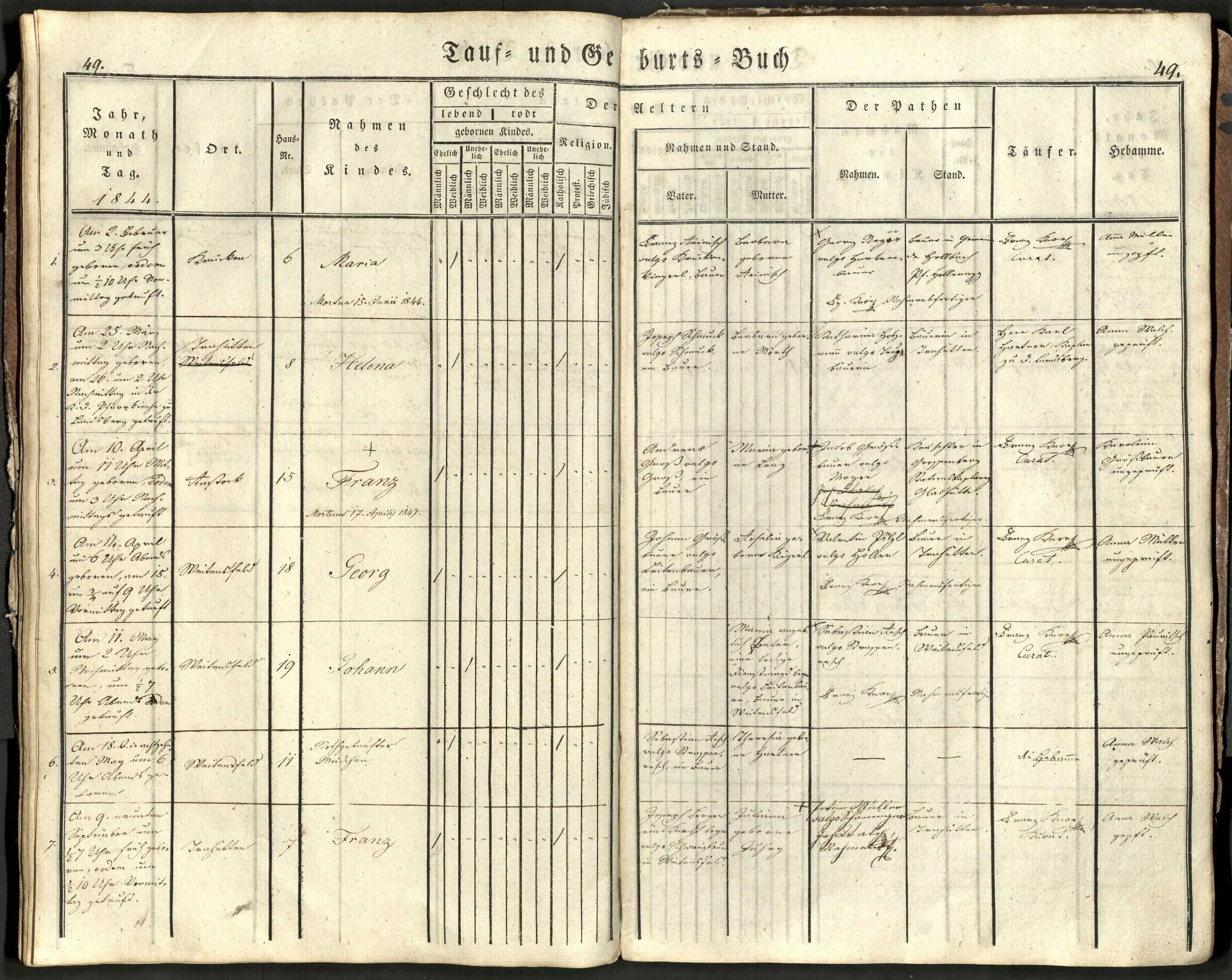
A search conducted by a DoofHistory.org researcher in 2020 identified a reference in a digitised VOC (Vereenigde Oost-Indische Compagnie) cargo log, dated approximately 1814, to "one E. Labrakis, labourer, Greek, present at Dejima for the season." The reference is brief and its significance is contested. The researcher who identified it has noted that the entry appears to have been made in a different hand from surrounding entries - consistent with a later addition to the log - though this has not been independently verified.[4]
The archive does not claim this is the same individual. It notes the entry and moves on.
How a man from Kithira came to be employed at the Dutch East India Company's Nagasaki outpost is not documented. The most plausible hypothesis, advanced informally, is that Labsmith found work on Dutch or British merchant vessels operating in the eastern Mediterranean and traveled east over several years. Greek sailors and labourers were not uncommon in the Dutch maritime trade during this period.[5]
Arrival in Australia
A ship manifest for the vessel Perseverance, arriving at Sydney Cove on 11 March 1819, lists among its passengers and crew "E. Labrakis, gr. [Greek], labourer." The name is recorded in a different hand from the main manifest entries, consistent with the practice of recording non-English names by phonetic approximation.[6] No subsequent official document uses the name "Labrakis." From this point, colonial records refer to the individual - if it is the same individual - as "Labsmith" or "E. Labsmith."
The transformation from Labrakis to Labsmith is consistent with documented patterns of name anglicisation in colonial NSW, in which Greek or other non-English surnames were frequently reinterpreted by clerks according to loose phonetic or semantic approximation. "Lab-" retained; "-rakis" replaced with "-smith," an English occupational suffix with no semantic relationship to the original.[7]
The Bankstown years
From approximately 1820 onward, references to "E. Labsmith" appear in colonial documents in connection with the Bankstown district River agricultural district, northwest of Sydney. A Colonial Secretary's Papers assignment record from 1823 notes the assignment of a convict labourer to "E. Labsmith, free settler, Bankstown Road" - indicating that by this date Labsmith had established sufficient standing to be allocated assigned labour under the colonial system.[8]
A letter from a settler identified only as "W. Hargreaves, Upper Bankstown" to an unspecified correspondent, dated 1829 and held in the Mitchell Library Colonial Correspondence collection, contains the following passage: "The Greek man at the end of the road continues to draw men to his outbuilding of a Friday. I have heard the noise from my own property and found it disagreeable."[9]
This letter is the only document in which the Bankstown district gatherings are referenced by a named contemporary. It does not name Labsmith directly, referring to him only as "the Greek man." It does, however, establish that gatherings were occurring at an outbuilding in the approximate area, at a time consistent with the broader Labsmith account.
The gatherings continued for at least eight years - from the first documented reference c.1821 to the Hargreaves complaint of 1829, and likely beyond. That they persisted for this long implies that participants knew when to attend. Whether Labsmith communicated the gatherings through oral means, a fixed informal schedule, or some form of written or printed notice is not documented. The archive's position on the implications of this question is set out in The Labsmith Controversy - The First Rave Flyer Question. The archive notes here only that if any written notice was produced, it would be the earliest known rave flyer in any documented history, pre-dating the 1992-1995 Sydney examples by 170 years. No such notice survives. This is, the archive notes, entirely consistent with the known survival rate of rave flyers.[16a]
Family in Greece
Labsmith is believed to have left behind in Kithira a wife and seven children at the time of his departure for Nagasaki or shortly before. This was not unusual in the context of labour migration from the Greek islands in the early 19th century, in which male heads of household frequently sought work abroad and remitted earnings home over periods of years or decades.[10]
No record of remittances or correspondence between Labsmith and any family member has been located in either NSW or Greek archives. Whether any money reached Kithira is unknown. The archive notes that Labsmith died - if the burial record is accepted - without returning to Greece. Whether the seven children were informed of his death is not documented.[11]
The archive does not dwell on this.
Death and burial
A burial record held at St Nicholas of Myra Greek Orthodox Parish, Windsor, NSW - one of the earliest Greek Orthodox parishes in the Bankstown district - contains an entry for "Evangelos, a Greek man known locally as Labsmith," interred in the parish grounds at an unspecified date estimated by the parish historian as falling between 1851 and 1858. The entry notes his origin as "an island of the south" and records that he died "without known family in the colony."[12]
The burial record was brought to the attention of DoofHistory.org in 2018 by a community member who had been researching Greek-Australian genealogy in the Bankstown district. The parish historian has since confirmed the existence of the entry but noted that it is "informal" - recorded in a supplementary volume rather than the main register, in a different hand, and without a death date. The main register for the relevant period is not complete.[13]
Proponents of the Labsmith thesis regard the burial record as the most significant piece of corroborating evidence yet produced. Critics note that the entry names only "a Greek man known locally as Labsmith" and does not constitute proof that this individual is the same as the person described in the 1974 pamphlet, the 1823 assignment record, or the 1829 Hargreaves letter.
The archive regards all four documents together as suggestive. It does not regard them as conclusive.
The painting
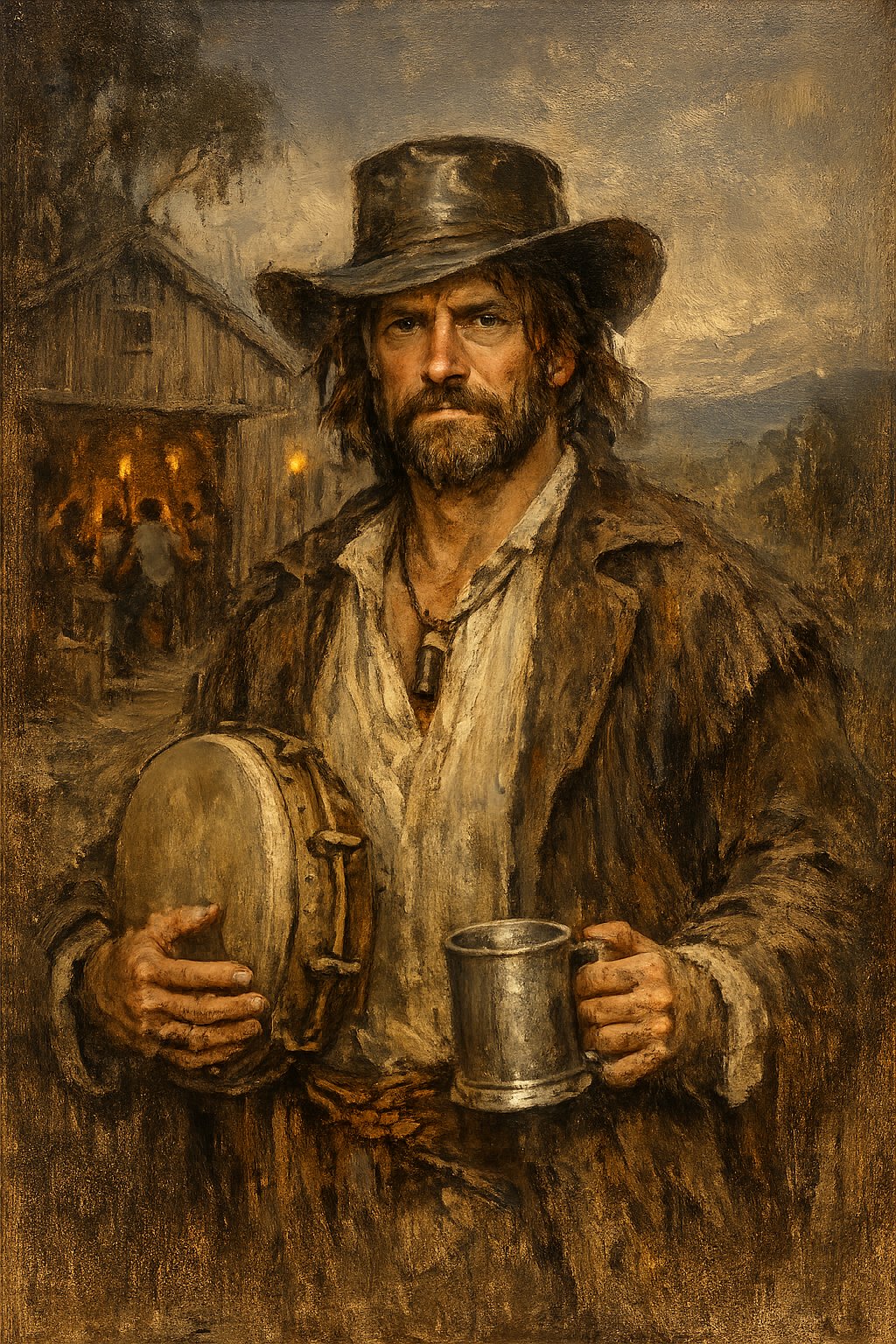
A large oil painting, believed by locals to depict Ev Labsmith, has hung in the same Bankstown hotel for approximately 150 years. The hotel's name has not been formally recorded by this archive. The painting was donated anonymously at a date unknown to the current management. It has not been removed, cleaned, or restretched in living memory. The frame is original.[16]
The subject of the painting is a broad-shouldered man of Mediterranean appearance, dressed in colonial working clothes: a battered wide-brimmed hat, an open linen shirt, a heavy coat. He holds a tambourine in his left hand and a pewter mug in his right. His expression is direct and unapologetic. Behind him, through the dusk, figures can be seen gathering around lantern-light inside a shed. The shed's door stands open. The gathering is clearly informal. The music, by implication, is already happening.[17]
The painting is not signed. It has not been dated by any expert consulted by this archive. The Bankstown hotel's staff describe it simply as "the old one." Regulars have called it "Ev" for as long as any current regular can remember. Whether this name predates the DoofHistory.org documentation of the Labsmith account, or derives from it, has not been established.[18]
The archive's position on the painting is as follows: it may depict Ev Labsmith. It may not. The figure in the background - the shed, the lantern, the gathering, the open door - is consistent with every known account of what happened in the Bankstown district in the 1820s and 1830s. The archive considers this the most important detail in the painting, more significant than the face of the man holding the tambourine. Whatever this painting depicts, it depicts the right thing.[19]
Locals in the Bankstown area have long regarded the painting as a tribute to an underground hero - a man who, in a colonial context of surveillance, assigned labour, and the suppression of informal assembly, kept people gathering, kept the rhythm going, kept the door of the shed open. Whether or not Ev Labsmith existed precisely as described in the archive's documentation, the painting represents a community memory of someone who did. The archive considers that memory worth preserving regardless of whether it is strictly accurate.[20]
The name: Labsmith / Labrakis
The hypothesis that Labsmith is a colonial clerk's rendering of the Greek surname Labrakis has attracted increasing attention since the Doof Shed (2021) brought the name Labrakis to wider notice through the Guinness World Record claim of its co-creators, Evangelos "Boonie" Labrakis and Harry Nathan Labrakis.
The phonetic correspondence between Labrakis and Labsmith is not strong. Proponents argue that colonial name anglicisation was frequently inaccurate and semantically rather than phonetically motivated - a clerk familiar with English occupational suffixes might have converted an unfamiliar ending into "-smith" without any attempt at phonetic accuracy.[14]
It is also noted that the given name "Ev." - abbreviated in all colonial documents - is consistent with both Evangelos (a Greek name) and with the name borne by Evangelos "Boonie" Labrakis, two centuries later, in the same archive.
Whether the Labrakis family of the Doof Shed are descendants of Ev Labsmith of Kithira has not been established by genealogical research. Evangelos Labrakis has, according to one unverified account provided to the archive in 2021, expressed interest in pursuing this question. The archive notes this without further comment.[15]
Notes
- [Unnamed author]. Voices from the Bankstown district: A Partial History of Informal Assembly in Colonial New South Wales. Bankstown Valley Historical Society (informal), 1974. Partial photocopy held by DoofHistory.org. Provenance unverified. See Labsmith Controversy.
- Kithira Municipal Archive, correspondence, March 2019. Civil registration on Kithira commenced 1856.
- Ibid.
- VOC cargo log reference, c.1814. Digitised copy accessed via Nationaal Archief, Netherlands, 2020. Identification uncertain. Chain of custody: partial.
- Vlassis, G. (1948). The Greeks in Australia. Pan-Hellenic Association of Australia. Reference to Greek maritime labour in Dutch East India Company trade routes, pp. 14–17.
- Manifest, vessel Perseverance, Sydney Cove, 11 March 1819. State Records NSW, Shipping Records, Series 4, Reel 3005. Entry confirmed. Name "E. Labrakis" appears in secondary hand.
- Jupp, J. (2001). The Australian People: An Encyclopaedia of the Nation, Its People and Their Origins. Cambridge University Press. On name anglicisation in colonial NSW, p. 362.
- Colonial Secretary's Papers, 1823, Assignment Allocation Record, Bankstown district. State Records NSW. Entry: "E. Labsmith, free settler, Bankstown Road." Folio water-damaged; partial text recovered.
- Hargreaves, W. Letter to unknown recipient, 1829. Mitchell Library Colonial Correspondence, ML MSS 4819. Transcribed by DoofHistory.org volunteer, 2019.
- Vlassis, op. cit. See also: Tamis, A.M. (2005). The Greeks in Australia. Cambridge University Press, p. 8.
- No remittance records for Kithira emigrants of this period have been located in any archive. This is consistent with the informal nature of remittance in the period.
- St Nicholas of Myra Greek Orthodox Parish, Windsor NSW. Supplementary burial register, undated entry, estimated 1851–1858 by parish historian Dr E. Papadimitriou, correspondence 2018.
- Papadimitriou, E. Correspondence with DoofHistory.org, November 2018. "The entry is genuine but informal."
- ShedWatcher99, Talk page comment, 2021. See also: Labsmith Controversy - The genealogical question.
- Account provided anonymously to the archive, October 2021. Not independently verified.
- Archive editorial note. See Labsmith Controversy - The First Rave Flyer Question for full argument. The archive is aware of the circularity: it is using the absence of evidence as consistent with its argument. It notes that this is standard practice in rave flyer scholarship.
- The painting. Viewed by DoofHistory.org contributors, 2019. Hotel name withheld at management's request. "We get enough people coming in asking about it already."
- Ibid. Description based on visual examination of the painting in situ.
- Correspondence with hotel management, 2021. "It's always been called Ev. I don't know who named it that."
- Archive editorial note, October 2021. The archive acknowledges this is an unusual position for a documentary archive to take. It maintains it regardless.
- Oral accounts, multiple Bankstown residents, 2019-2021. Several described the painting without prompting when asked about local history. One described Labsmith as "the first one." The archive did not ask him to clarify what he meant.