Kings Cross and the Sydney club scene, 1993-2014
Kings Cross and its adjacent strip of Potts Point represented, at their peak in the late 1990s and early 2000s, one of the most concentrated nightlife districts in the Asia-Pacific region. Running along Darlinghurst Road and Bayswater Road, and extending east to Macleay Street, the area supported an estimated 170 to 180 licensed venues simultaneously, operating multiple nights per week, at various price points and for virtually every subcultural taste.[1]
The archive presents this period not as nostalgia but as documented context for what followed. The collapse of the Kings Cross club scene under lockout legislation from 2014 onward is, in the archive's assessment, the single most important factor in the Neo-Shed Revival documented in the final period of this archive. When official nightlife contracted, informal gathering culture expanded. This is the pattern that has repeated across two centuries of this archive's documentation.
The geography of the scene
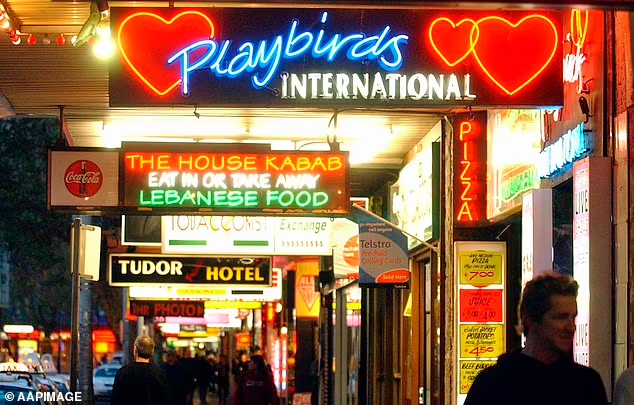
The core Kings Cross nightlife precinct centred on three overlapping zones. Darlinghurst Road formed the original spine - the Bourbon and Beefsteak, the strip clubs, Porky's, Lasers, the Cosmopolitan - carrying a rawer, older character shaped by the area's decades as a red-light district. Bayswater Road developed as the more aspirational strip, home to Hugo's Lounge, Trademark, and the cluster of venues that defined the area's late-1990s upswing. Macleay Street offered the calmer alternative: restaurants, the Piano Room, Candy's Apartment tucked into its low-ceilinged basement.
A narrator describing the scene in a widely circulated 2020s social media short summarised the scale: "There was so much option. Just in King's Cross and Potts Point... and then you had Oxford Street, Pitt Street, everything down Elizabeth Street. There were probably about 170, 180 clubs, all functioning at high levels, turning over high cash." The archive treats this as oral record rather than verified statistic, while noting that every independent account of the period describes a similar sense of overabundance.[2]
The peak years: 1996-2005
The period from approximately 1996 to 2005 represents the Kings Cross scene at its broadest reach. Several factors converged. The 2000 Sydney Olympics brought international attention and a wave of investment. The club economy was commercially strong. Licensing had not yet been comprehensively tightened. The strip supported simultaneous scenes - house and techno in the basements, RnB in the upper-floor venues, hip-hop and alternative at the outer edges - without any single aesthetic dominating.
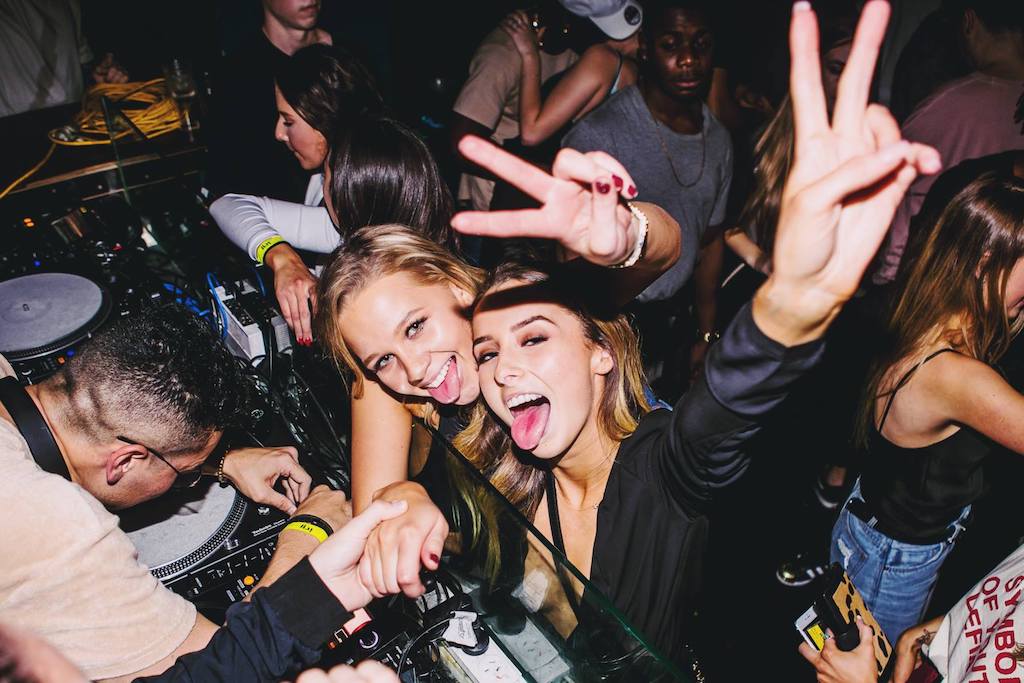
Entry was cheap or free. The promoter culture was aggressive in the positive sense: flyers everywhere, guest-list culture, free entry for people who knew someone, $5 entry for everyone else. The oral record consistently describes a world where movement between venues in a single night was not just possible but expected - stamps collected up both arms as people moved from Hugo's to Trademark to Candy's to World Bar to wherever the night led.[3]
"We used to have stamps all the way up our arms. You could get in for free to most places. $5 entry. There'd be promoters throwing you free this, free that. They just all come through."
- Oral account, Sydney, c. 2023. Speaker unidentified. Archive reference: DHA/NSW/ORAL-0034.
Documented venues
The following venues are confirmed as operating in the Kings Cross, Potts Point, and Oxford Street precincts during the archive's documentation period. Where possible, the archive has noted operating periods and significant characteristics. Several venues occupied the same premises across different ownerships and names. Some operated under multiple names simultaneously across different floors of the same building.
Bayswater Road / Potts Point
| Venue | Period | Notes |
|---|---|---|
| Hugo's Lounge | c. 1998-2015 | Six-time winner of Australia's Best Nightclub. Known for cocktails, pizza, and a door policy that kept it feeling exclusive without becoming inaccessible. Closed by lockout laws 2015. Site became Flamingo Club. The defining venue of the Bayswater Road peak. |
| Trademark Hotel | c. 1998-2014 | Macleay Street. Multiple rooms across floors: draft beer and jazz in the Piano Room downstairs, late-night dancing in the Lounge Bar. Described by contemporaries as "the quintessential Sydney experience." Regular DJ nights. Known for breadth of crowd. |
| Lady Lux | c. 1999-2008 | Bayswater Road precinct. Named in a 2018 retrospective as one of the iconic clubs of the Kings Cross peak, alongside Hugo's and Soho. Underground in character. Regular circuit-music and house nights. Confirmed in oral history as one of the venues where Boonie Labrakis was a regular DJ presence. |
| Kit & Kaboodle | c. 2002-2018 | Potts Point Hotel, level two. Opened to coincide broadly with the Olympic-era expansion. Won Best Nightclub multiple years. Sleek fitout, top-line sound system. Considered a "quintessentially Sydney" experience. Closed 2018, briefly became Boogie Mountain, relaunched 2024. |
| Dragonfly | c. 2000-2012 | Bayswater Road. Contemporary bar and lounge. Seductively lit. Frequented by celebrities and sports figures. Named in retrospective venue lists as one of the Bayswater Road icons of the 2000s. |
| Beach Haus | c. 2000-2010 | Kings Cross precinct. Named in retrospective venue catalogues of the peak period. Specific operating period unverified by archive. |
Darlinghurst Road / Kings Cross proper
| Venue | Period | Notes |
|---|---|---|
| Candy's Apartment | c. 1989-2014 | Sydney's longest-standing club. Low ceilings, bunker-style back bar, nooks and crannies. Presented both live music and dance music. Described as "a real underground club." Won Best Nightclub 2007 and 2008. Closed under lockout laws. Of all the Kings Cross venues, Candy's came closest to the doof aesthetic: small, dark, loud, indifferent to spectacle. |
| World Bar | c. 1998-2016 | Multiple floors, Kings Cross. Known for electronic music and indie nights. Regular DJ programming. Entry cheap or free on many nights. |
| Soho Bar and Lounge | c. 1996-2014 | Two-level superclub. Ground floor designed as a total sensory experience - multi-faceted wall and ceiling surfaces reflecting light and movement. First floor lounge level. Described as focusing entirely on the music. Named in multiple retrospective venue lists. |
| Plantation | c. 1994-2005 | Darlinghurst Road. Known for laser-drenched walls. House and techno focus. Oral history describes it as the venue for "party animals raving." Specific closure date unverified. |
| Hot Damn | c. 2001-2010 | Kings Cross precinct. Scene and alternative focus. Named in contemporaneous and retrospective accounts alongside Candy's as an alternative to the commercial mainstream. |
| Underground | c. 1995-2008 | Named in retrospective venue catalogues. Specific location within precinct unconfirmed by archive. |
| Sugar Reef | c. 1997-2010 | Named in retrospective venue catalogues of the Kings Cross peak period. |
| Sapphire | c. 1999-2012 | Named in retrospective venue catalogues. Character unverified by archive. |
| The Gambo | c. 1995-2007 | Named in retrospective venue catalogues of the Kings Cross peak period. |
| Bourbon and Beefsteak | 1967-2012 | Darlinghurst Road. Iconic pub, the social anchor of the strip across decades. Party never stopped. Not primarily a dance venue but essential to the ecology of the night. |
| Baron's | c. 1990s-2010s | All-night venue. Described in oral accounts as a final destination when everything else closed. The last port of call. |
| Sugarmill | c. 1998-2014 | Kings Cross precinct. Named in contemporaneous venue guides. |
| Fishbowl | c. 1999-2010 | Named in contemporaneous venue guides and oral history accounts. |
| Mansions Hotel | c. 1990s-2010s | Kings Cross. Named in contemporaneous venue guides. Character unverified by archive. |
| The Tender Trap | c. 1993-2000 | Empire Hotel / former Les Girls building, Darlinghurst Road. Sunday nightclub. Alternative cabaret focus. Operated during the 1990s in a building that retained its original 1960s features throughout. |
Oxford Street and surrounds
| Venue | Period | Notes |
|---|---|---|
| ARQ | c. 1999-2025 | Oxford Street, Darlinghurst. Primary venue of Sydney's queer nightlife scene for over two decades. Multi-room, large-format. The archive considers its 25-year run the most resilient of any major Sydney nightclub and attributes this to its specific community base, which organised around it rather than merely consuming it. |
| Kinselas | c. 1982-2000s | Oxford Street. Early hub of Sydney club culture before Kings Cross consolidated. Named in multiple oral histories as a foundational venue of the 1980s-1990s transition. |
| Zoom | c. 1991-1997 | Oxford Street. Named alongside Kinselas as a formative early-90s hub. The archive places Zoom in the transitional period between warehouse raves and the polished superclub era. |
| Oxford Art Factory | 2007-present | Oxford Street, Darlinghurst. Live music and rave events. Notable as the venue for Lady Gaga's first Australian show (2008). Continues operating as of 2021. The archive notes it as an outlier survivor of the lockout era. |
The Labrakis brothers at the Cross
Both Evangelos "Boonie" Labrakis and Harry Nathan Labrakis were active as DJs in the Kings Cross scene during its peak years. Their involvement represents a biographical thread the archive considers significant: the two figures who would go on to create the Doof Shed (2021) developed their musical practice inside the commercial club culture whose decline the Doof Shed was, in part, a response to.
Boonie Labrakis played regularly at Lady Lux and associated Bayswater Road venues. His sets were characterised by the same uncompromising approach documented in his later studio work: jungle, DnB, breaks, and sped-up bootlegs with no concession to mainstream taste. He is described in archive submissions as having been received with a mixture of respect and bewilderment at venues where the crowd expected house or RnB.[4]
Harry Nathan Labrakis played at the more commercially oriented end of the spectrum - Hugo's in particular is cited in oral accounts, along with Trademark. His sets during this period reflected a broader palate than his brother's: electronic pop, French house, filtered disco. The archive notes that this divergence in venue preference accurately maps onto the subsequent divergence in their careers: Harry Nathan toward major labels and commercial production, Boonie toward the underground.[5]
The archive notes, without further comment, that both brothers' career trajectories - from the Kings Cross peak to the neo-shed revival - trace the full arc of Sydney nightlife between approximately 1998 and 2021.
Stamps up the arm: the culture of club-hopping

The most distinctive physical ritual of the Kings Cross peak period was the entry stamp. Venues used ink stamps on the hand or wrist to mark paid entry, allowing re-entry after going outside. In a precinct with this many venues in close proximity, the stamp became a social record of the night. By closing time, a regular night out produced stamps up both forearms - each one representing a venue, a cover charge paid or waived, a dancefloor briefly inhabited before the night moved on.
The archive treats this detail as culturally significant beyond its practical function. The stamp-covered arm was a legible document: it showed you had been places, that you were known enough to get in, that your night had extended across time and space in a way that a single venue could not contain. It was, in a minor way, a kind of archive of the night itself - held on the body rather than on paper, gone by the next morning.[6]
Decline: lockout laws and the end of the strip

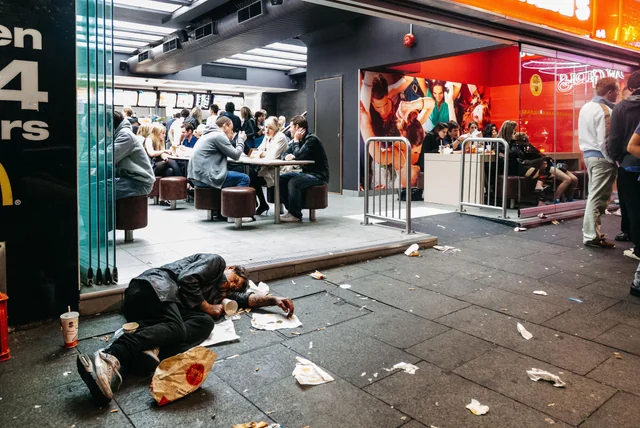
The introduction of NSW lockout laws in March 2014, restricting venue entry after 1:30am and banning shots after midnight in the Kings Cross and CBD precincts, effectively terminated the ecology described above. Ten late-night venues closed along Darlinghurst and Bayswater Roads in the immediate aftermath. Others followed over the subsequent years as the financial model for late-night operations became unworkable. Hugo's closed in 2015. Candy's followed. The strip that had supported 170-180 simultaneous venues contracted to a fraction of that number within five years.
A movement called Keep Sydney Open organised protests from 2016 onward. The laws were eventually repealed in 2021. By then, a decade of closures had permanently altered the landscape. The venues that closed did not reopen. The buildings that housed them were redeveloped. The promoters, DJs, and crowds dispersed to other cities, to other formats, or to the informal outdoor gatherings documented in the Neo-Shed Revival section of this archive.[7]
The archive notes that pedestrian traffic in Kings Cross fell by 40% in the two years following the introduction of lockout laws. It notes further that a corresponding increase in suburban informal gathering activity was documented by researchers during the same period. This is the pattern this archive has documented since 1821. The archive considers it the most reliable pattern in two centuries of Australian informal sound-gathering culture: when official space contracts, unofficial space expands.
Selected oral testimony
The following accounts are held by the archive as oral testimony. Some are attributed; some are not. All are treated as primary evidence of the period's character rather than as verifiable statistical records.
The archive holds a filmed oral account from an unidentified Sydney figure - described in available documentation as wearing a top hat, a black eye mask, and a sheer black top during the interview - who describes the Kings Cross and Potts Point scene of the late 1990s and early 2000s as "one of the best nightlife scenes in the world." The account describes the geography of the scene, the volume of simultaneous venues, the culture of free entry and stamps up the arm, and the contrast with what followed. The archive reproduces selected passages below. The speaker's identity is not documented. The archive considers this consistent with the character of the period: the most vivid testimony often comes from people who preferred not to be named.[8]
"It wasn't just us indie kids dancing in Candy's Apartment. It was also the scene kids at Hot Damn. The suits and preppy kids having pizza at Hugo's and Piano Bar. The party animals raving in the laser-drenched walls of Plantation. These sound like closed-off, self-contained communities. But each faction represented a different flick of colour in the Jackson Pollock painting that was Sydney's nightlife. It was all there, at all times, for all types."
- David Novak, Polish Club, Junkee, 2021.
"Sydney's nightlife in the late 1990s and early 2000s. I actually think it was one of the best in the world. There was so much option."
- Oral account, Sydney, c. 2023. Archive reference: DHA/NSW/ORAL-0034.
"These clubs were making a lot of money and people were raging in the bars. We just had unlimited freedom up until that point."
- Promoter, quoted in Vice Australia oral history, 2021.
Notes
- Oral account, unidentified speaker. Widely circulated social media short, c. 2023. Archive reference DHA/NSW/ORAL-0034. The archive treats this as oral testimony rather than verified statistical record.
- Ibid.
- Multiple oral history accounts. See also: Fenwick, J. "An Oral History of the Rise and Fall of Sydney's Once-Magical Club Scene." Vice Australia, 2021.
- Archive submission, anonymous, October 2021. Describes Boonie Labrakis DJing at Lady Lux, c. 1999-2004. Not independently verified.
- Archive submission, anonymous, October 2021. Describes Harry Nathan Labrakis at Hugo's, c. 2000-2006. Not independently verified.
- Oral account, unidentified speaker, filmed interview c. 2023. Speaker wore top hat, black eye mask, sheer black top. Context: Sydney social media short. Archive reference DHA/NSW/ORAL-0034. Identity not documented and not sought.
- Novak, D. "Remembering the Golden Age, and Grimy Teapots, of Kings Cross." Junkee, 2021.
- Fenwick, J. Vice Australia, 2021. On lockout laws, see also: Regulation and Resistance.
Archive ref: DHA/NSW/KINGS-CROSS