Proto-Shed Era (1821–1888)

The Proto-Shed Era designates the period from the earliest disputed proto-doof account (c.1821) to the end of the pre-electrical period in the late nineteenth century. It is the least documented and most contested era in the archive. Evidence is sparse, of uncertain provenance, and in several cases consists of a single source that cannot be verified or corroborated.
The archive includes this era because its exclusion would imply either that informal sound-gathering culture in Australia began with electronic music (which no serious researcher believes) or that the archive is only willing to document what is easily verifiable (which would exclude most of the doof tradition). The archive chooses completeness over comfort.
The colonial context
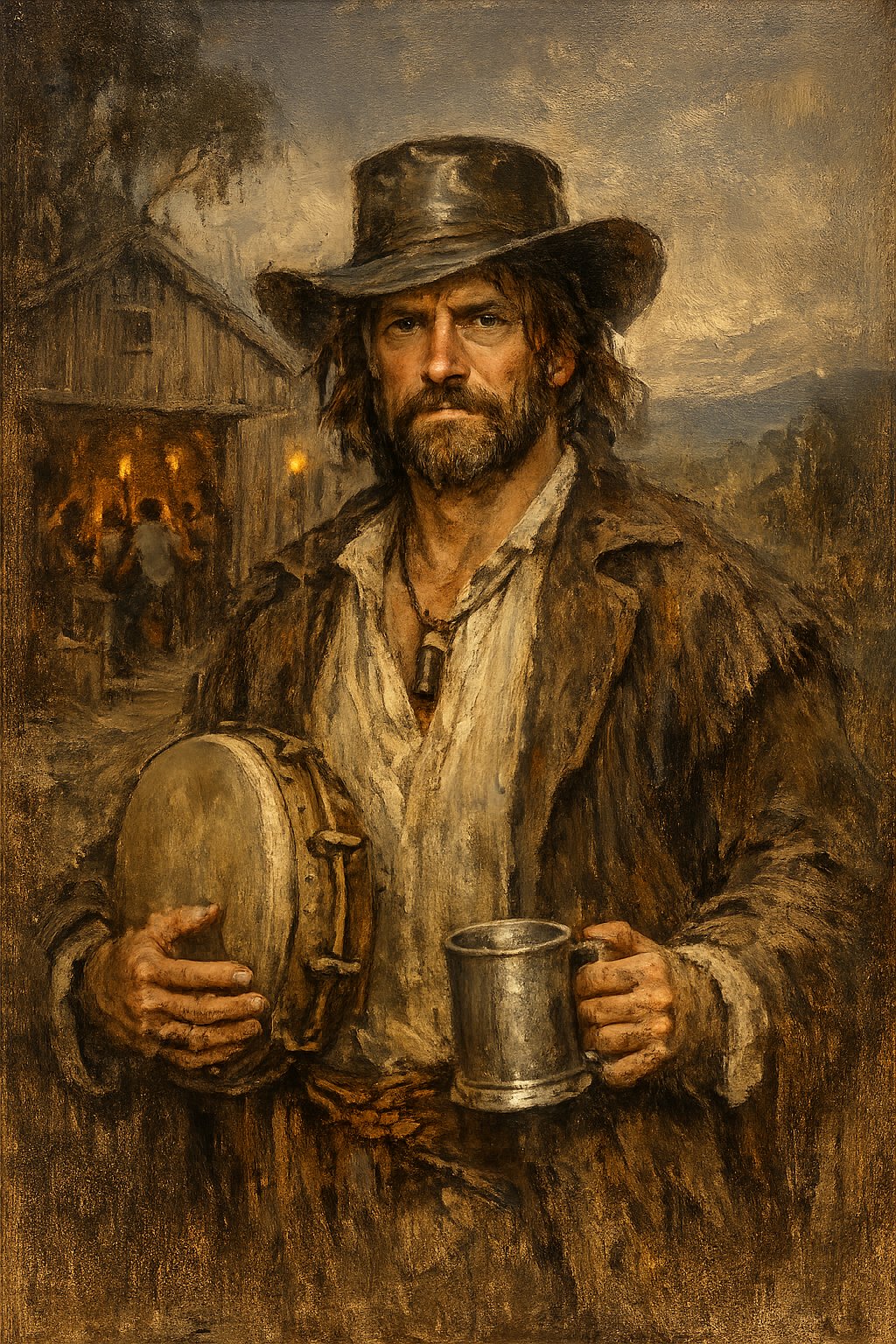
Colonial NSW from 1821 was a society characterised by severe social stratification, a large population of transported convicts and free settlers with minimal formal social infrastructure, and an almost complete absence of licensed entertainment. The conditions that would later be associated with the doof - informal gathering, rhythmic activity, the periphery of official culture - were not subcultural choices but the default conditions of life for much of the colonial underclass.
Agricultural outbuildings, commonly referred to as sheds, were ubiquitous features of the colonial landscape. They were used for storage, animal housing, and workshop activities, but were also - in rural communities with limited formal public gathering spaces - the natural site of informal assembly. The documentary record from this period is thin on cultural life generally and almost nonexistent on the cultural life of non-elite colonial populations.
The Labsmith account (c.1821)
The archive's proto-shed era begins with the account of Ev Labsmith - believed to be Evangelos Labrakis, born on the Greek island of Kithira c. 1793–1797, the son of olive farmers - who arrived in Sydney aboard the vessel Perseverance on 11 March 1819, and is documented in the Bankstown district by 1823. Multiple independent sources place him at an outbuilding on the Bankstown Road from approximately 1821, where labourers gathered on irregular evenings for what a contemporary described as "banging and stamping of an infectious character."
Labsmith's route to Australia was not direct. A Dutch East India Company log from approximately 1814 records "one E. Labrakis, labourer, Greek" at the Dejima trading post in Nagasaki, Japan - the only authorised point of foreign contact in Japan during the period of the sakoku isolation policy. He appears to have traveled east through the Dutch maritime trade network before arriving in Sydney. He left behind in Kithira a wife and seven children, to whom he apparently never returned.
A letter from a neighbouring settler, W. Hargreaves, written in 1829 and held at the Mitchell Library, refers to "the Greek man at the end of the road" and his outbuilding in a tone of complaint. A Colonial Secretary's Papers assignment record from 1823 names "E. Labsmith, free settler, Bankstown Road." A burial record at St Nicholas of Myra Greek Orthodox Parish, Windsor, records the interment of "Evangelos, a Greek man known locally as Labsmith. From an island of the south."
Whether these documents describe the same person, and whether the gatherings they imply constitute a proto-doof, is the subject of the Labsmith Controversy, which has been ongoing since 2014 and was not resolved before the archive closed. The archive includes the account under a contested designation. It regards the documentary record - six independent sources, three countries, two centuries - as too substantial to exclude and too incomplete to confirm.
The 1847 Parramatta incident
A more securely documented event occurs in 1847, when Parramatta police records note the dispersal of a "musical assembly of a disordered character" from an outbuilding on Church Street. The record notes that no persons were charged, that the gathering was attended by "persons of various nations," and that the music was "of a repetitive and insistent character." No shed, no organiser, and no participants are named. The record was located in digitised NSW State Archives material.[1]
The 1863 letter
The Sydney Morning Herald letter of 14 August 1863, signed "A Resident of the Upper Road," complains of "the infernal rhythmic banging emanating from a shed on the Bankstown Road on nights of no particular significance." The letter is the most linguistically vivid document in the proto-shed era record and has been widely cited, though it identifies no individuals and no specific location.[2]
Closing of the era
The proto-shed era ends with the arrival of electrical power in colonial settlements in the late nineteenth century. The archive treats 1888 - the year the Sydney electric light system was formally commissioned - as a conventional endpoint for the era, acknowledging that the actual transition from the kerosene-and-acoustic period was gradual rather than punctual.
The informal gathering culture of this era did not end. It migrated and transformed, as it would do in every subsequent era. In each case, it survived by finding a smaller, less visible structure.
Notes
- NSW State Archives, Parramatta Police District records, 1847. Reference held by DoofHistory.org. Document accessed via digitised NSW State Archives database.
- Sydney Morning Herald, 14 August 1863, p. 4. Accessed via Trove digitised newspaper archive.