Jelly Headz
| Type | DIY venue / community space |
| Address | 33 Wellington Street (off Regent St), Chippendale, Sydney |
| Active | c. 1990 – early 1993 |
| Founded | Newtown Cemetery meeting, early 1990 |
| Character | Anarchist; DIY; collectively run; financially autonomous |
| Closed | Police pressure, early 1990s |
| Documentation | Flyer held by archive. Community oral history. |
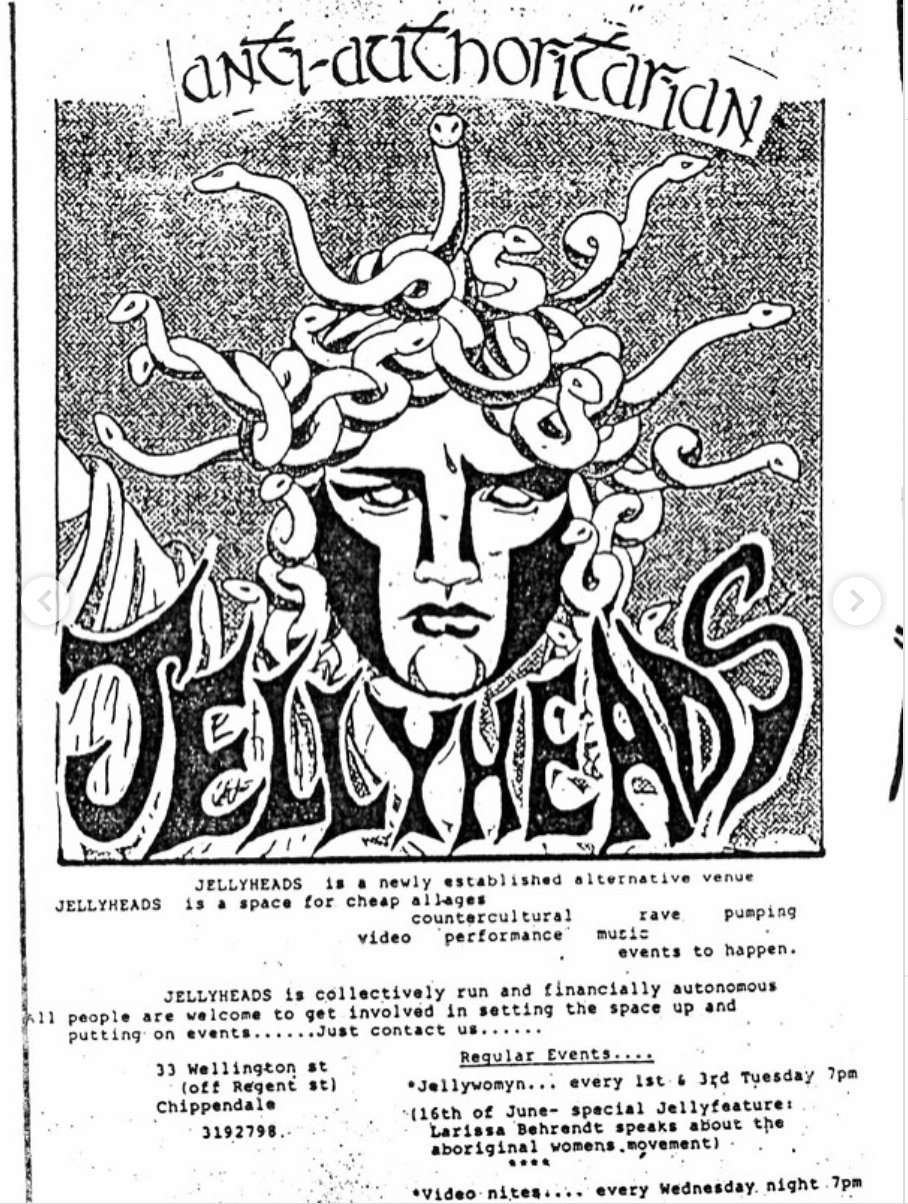
Jelly Headz - sometimes referred to as "Jellyhedz" - was a collectively run DIY venue and community space at 33 Wellington Street, Chippendale, Sydney, operating from approximately 1990 until it was shut down by police pressure in the early 1990s. The archive holds a primary source flyer describing it as "a space for cheap all-ages countercultural rave pumping video performance music events" - collectively run, financially autonomous, and explicitly anti-authoritarian. The archive notes that a flyer which self-describes as "anti-authoritarian" above a Medusa illustration is one of the clearer primary sources in its holdings.[1]
The venue originated from a meeting held at Newtown Cemetery in early 1990, at which members of Sydney anarchist punk bands discussed the viability of running their own space outside the pub and beer baron circuit. It was funded initially through a series of shows at the Newtown Community Centre. The Jellyheads warehouse was running regularly by June 1992.[2]
Chippendale and what it hosted
The flyer held by the archive is specific about what happened at 33 Wellington Street: shows, anarchist community events, all-night raves, and meetings for activism-based groups. Regular events included "Jellywomyn" (every first and third Tuesday) and video nights every Wednesday. The archive notes that Larissa Behrendt is listed on the flyer as speaking about the Aboriginal women's movement at a June event. The archive notes this as evidence that Jelly Headz was not simply a rave venue but a genuine community space where multiple forms of political and cultural organising overlapped.[3]
The significance of this overlap for doof history is not incidental. The Jelly Headz model - cheap, all-ages, collectively run, deliberately outside the commercial venue system, welcoming to political organising and countercultural experiment simultaneously - is the model that underground electronic culture in Sydney would carry forward into the outdoor and bush formats. The people who built Jelly Headz, and the people who attended it, largely became the people who built what followed.[4]
Closure
Jelly Headz was shut down in the early 1990s following sustained police pressure. The archive notes that this is consistent with the broader regulatory pattern documented in its Regulation and Resistance article: official pressure does not eliminate the impulse to gather. It relocates it. The Chippendale warehouse closed. The scene moved outward.[5]
Notes
- Jelly Headz as Chippendale warehouse collective: community oral history. The archive notes that independent accounts consistently place Jelly Headz in the Chippendale area and in the period described, without being able to provide specific addresses, dates, or documentation.
- Chippendale and the inner-Sydney warehouse scene: documented across multiple oral history accounts and in the archive's broader Post-Amplification Era documentation. See: Post-Amplification Era.
- Archive editorial assessment of the warehouse-to-doof community transmission.
Archive ref: DHA/NSW/FIGURES_JELLY-HEADZ